Big Idea? Better Test! Why Relying on Gut Feelings Can Be Costly for Creatives
Management Summary

By Hugo Leão, Art Director & Creative Lead, and Sophie Kubec, UX & Creative Operations Lead.
Hugo Leão is an expert in art direction and campaign conception. As Art Director and Creative Lead at e-dialog, he develops ideas for brands, from strategy to the finished asset.
Sophie Kubec is an expert in user experience and optimization. As UX & Creative Operations Lead, she has been advising international brands for over ten years on topics such as usability, A/B testing, landing pages, and conversion optimization.
“Come up with a few ideas” is not a briefing
If you work in the creative side of the advertising industry, you’ve probably heard it before… And if you’re on the client side, you’ve probably said it yourself: “Come up with a few ideas.”
This is a question that prompts creative people to ask, “Yes… but what kind of idea?” Then everyone looks at each other because no one really knows what “kind” actually means.
Ideas come in all sizes. A big idea isn’t automatically a good one, and a small idea isn’t necessarily a bad one.
The biggest mistake we see in our day-to-day work is asking for ideas without knowing what scale we’re actually looking for—which often ends up costing more than necessary.
Here are three categories or types of ideas, each with its typical pitfall and a “test” you can use to quickly figure out if it’s the right fit for you.
The “One-off” Idea
What It Is
A one-off is an idea that exists in a single incarnation, for a single moment. It may be brilliant, but once that moment is over, so is the idea.
The Trap
A one-off idea isn’t designed to scale and falls apart the moment you try to build an entire campaign around it.
The Test
Ask yourself, “Could I turn this idea into a series?” If so, the idea is bigger than a one-off. If not, you have a one-off idea on your hands.
Example #1: BIC, “Infinity”
How do you advertise a ballpoint pen whose selling point is ink that lasts almost indefinitely? The concept was a hand-drawn infinity symbol made up of countless overlapping blue ink loops, visually demonstrating the extreme writing capacity of a single BIC pen. The strategy behind it was a minimalist ad that does away with headlines and body copy entirely, relying solely on this powerful visual metaphor.
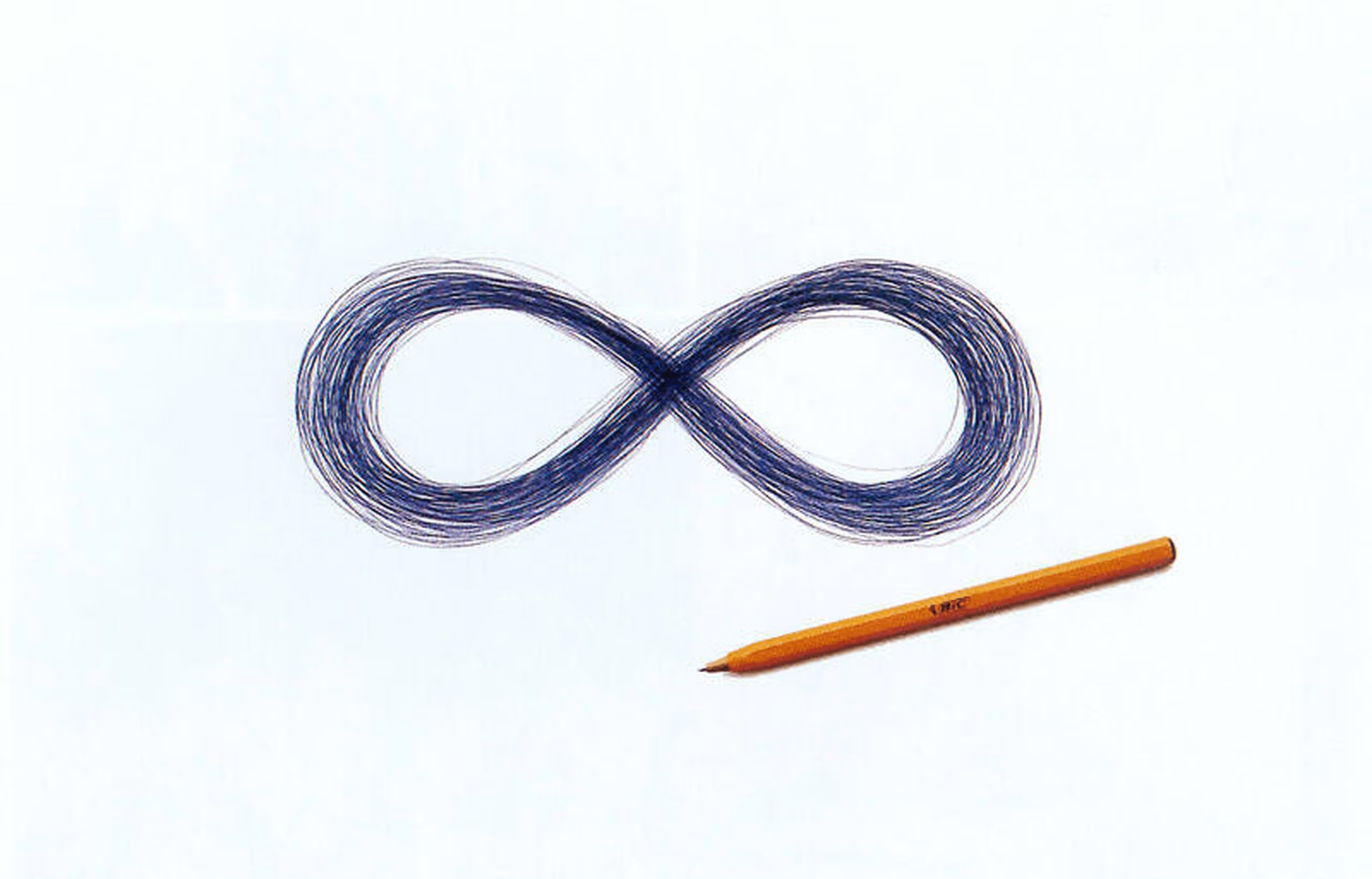
Source: BIC, TBWA\Hunt\Lascaris (South Africa), “Infinity,” 2005.
Example #2: LASSA, “Tire Call Center”
How do you visually link a customer helpline with the performance of tires? The idea was an ad featuring a phone cord that seamlessly transitions into a spiral of tire tread. The creative concept cleverly combines a phone cord with car tires to promote a customer helpline and show that professional help is just a phone call away.
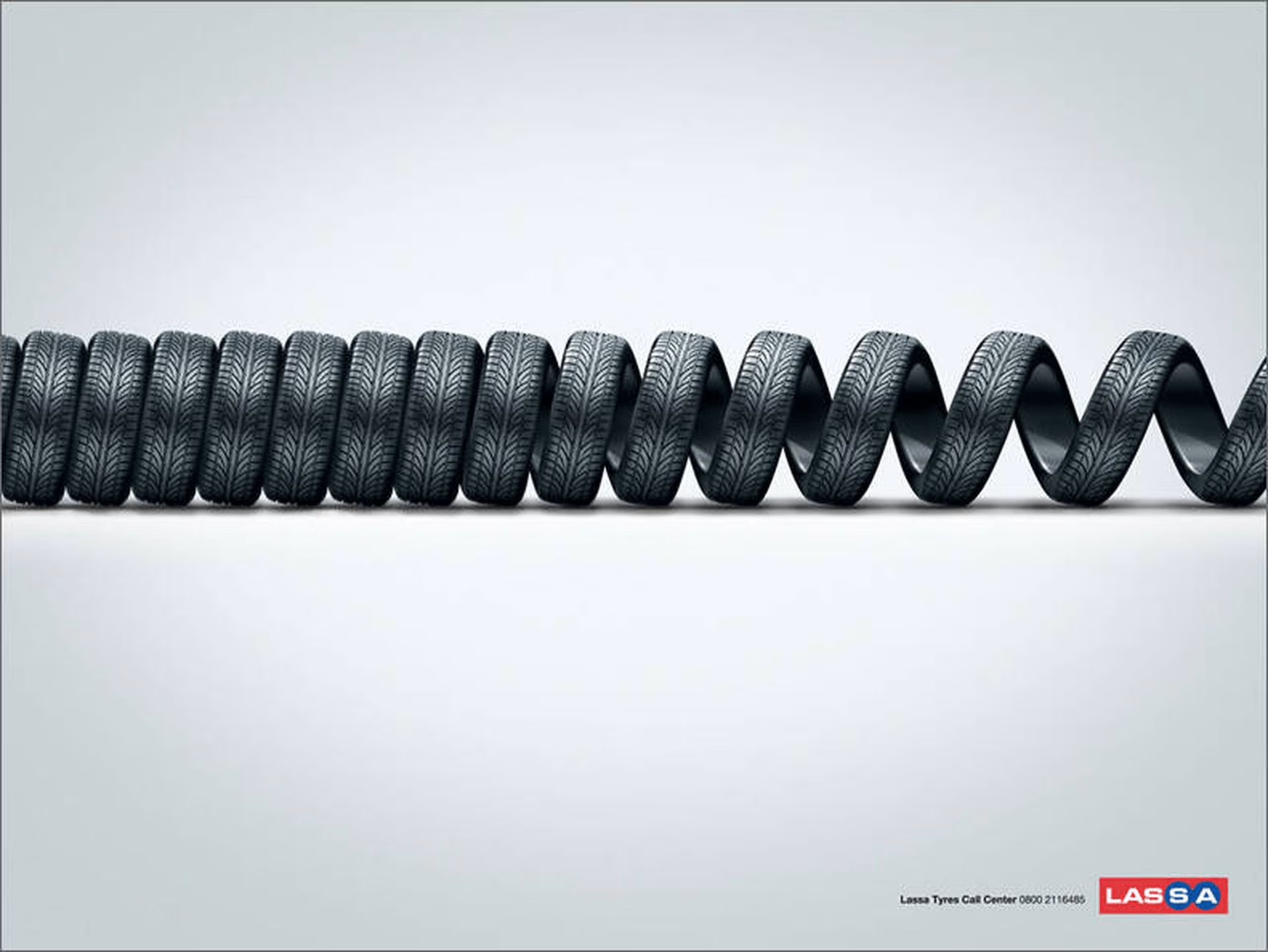
Source: Lassa Tyres, “Helpline,” 2006.
The “Campaignable” Idea
What It Is
A medium-sized idea designed to run for months—sometimes even a year. It features a flexible core mechanic, allowing the idea to be played out across various touchpoints—with variations that slightly adapt it while remaining true to its core.
The Trap
Don’t confuse reach with repetition. If every execution repeats the same pun or the same visual, you haven’t yet proven that the idea can truly scale.
The Test
Ask yourself: “Can I brief three different variations based on this idea without forcing it?” If each one stays true to the core while still standing on its own, the idea is campaign-ready. If you have to twist the idea to make it fit for a second implementation, it’s still a one-off idea.
Example: Burger King, “The Moldy Whopper”
A time-lapse video of a
Whopper
naturally developing mold over the course of 34 days. Here, the mold became visual proof of “no artificial preservatives”—rather than a flaw that needed to be hidden. The idea was then scaled up to a hero film, photography, out-of-home advertising, social media clips, and PR, with each format reimagining the same core concept.
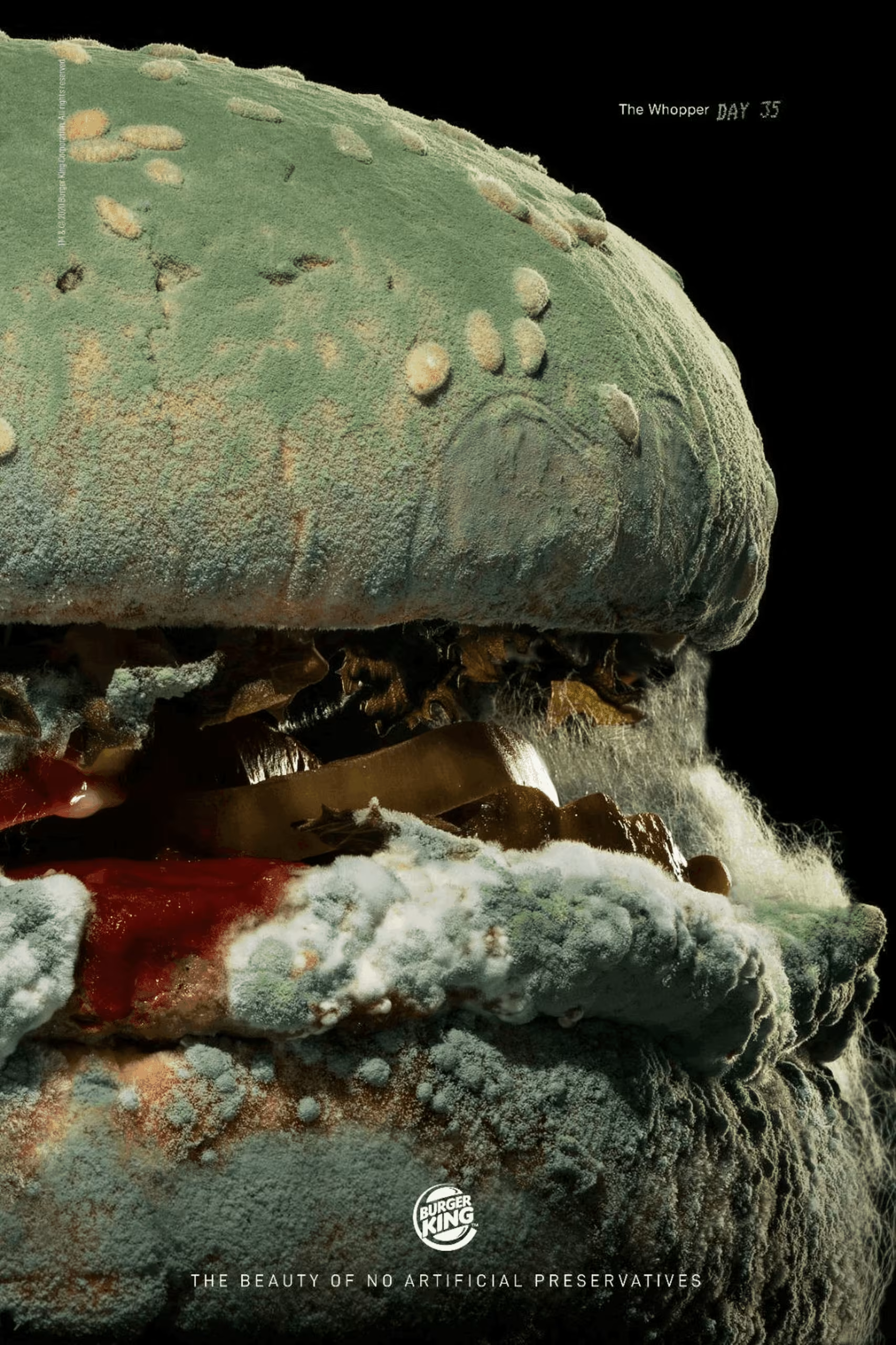
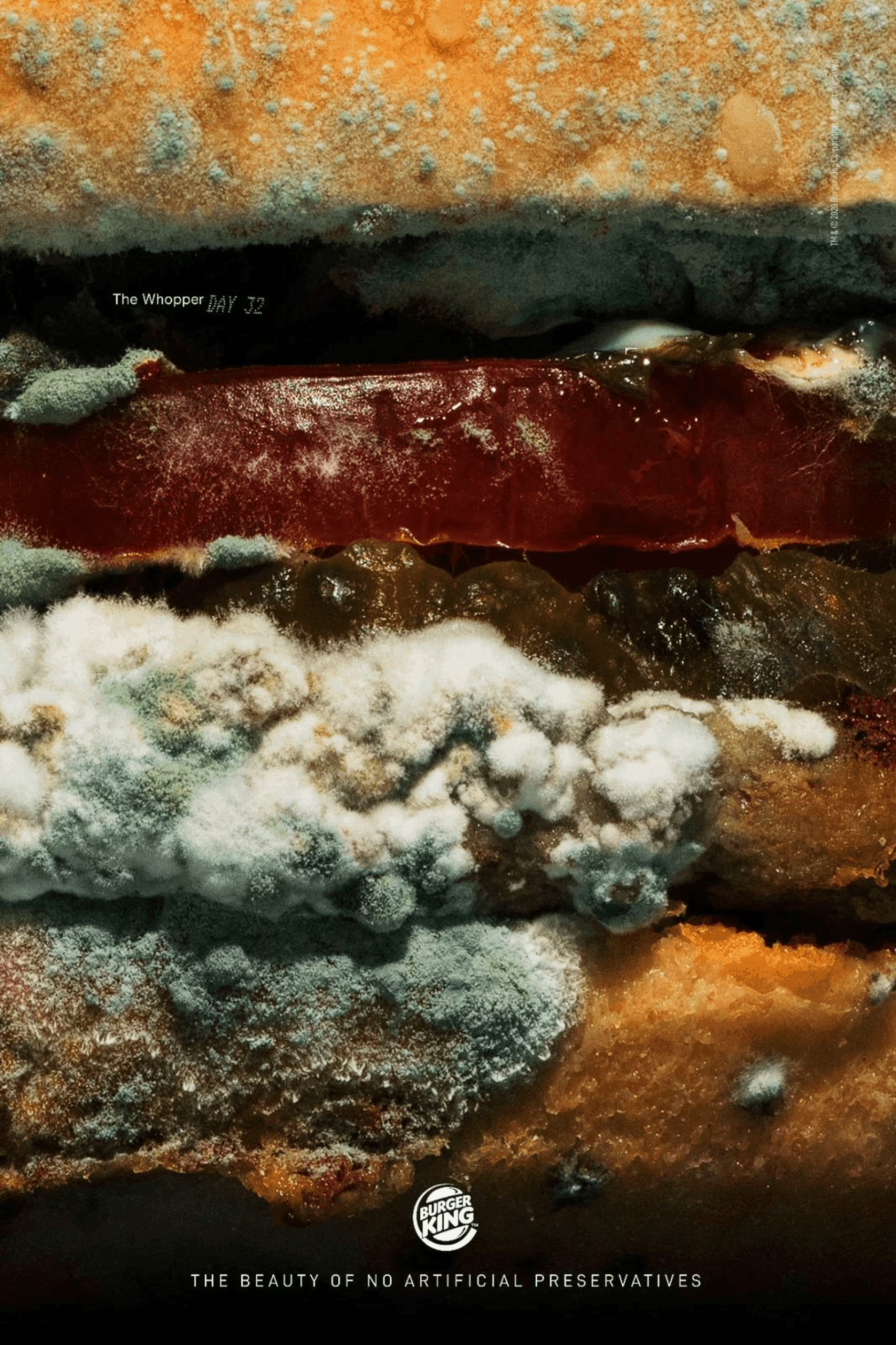

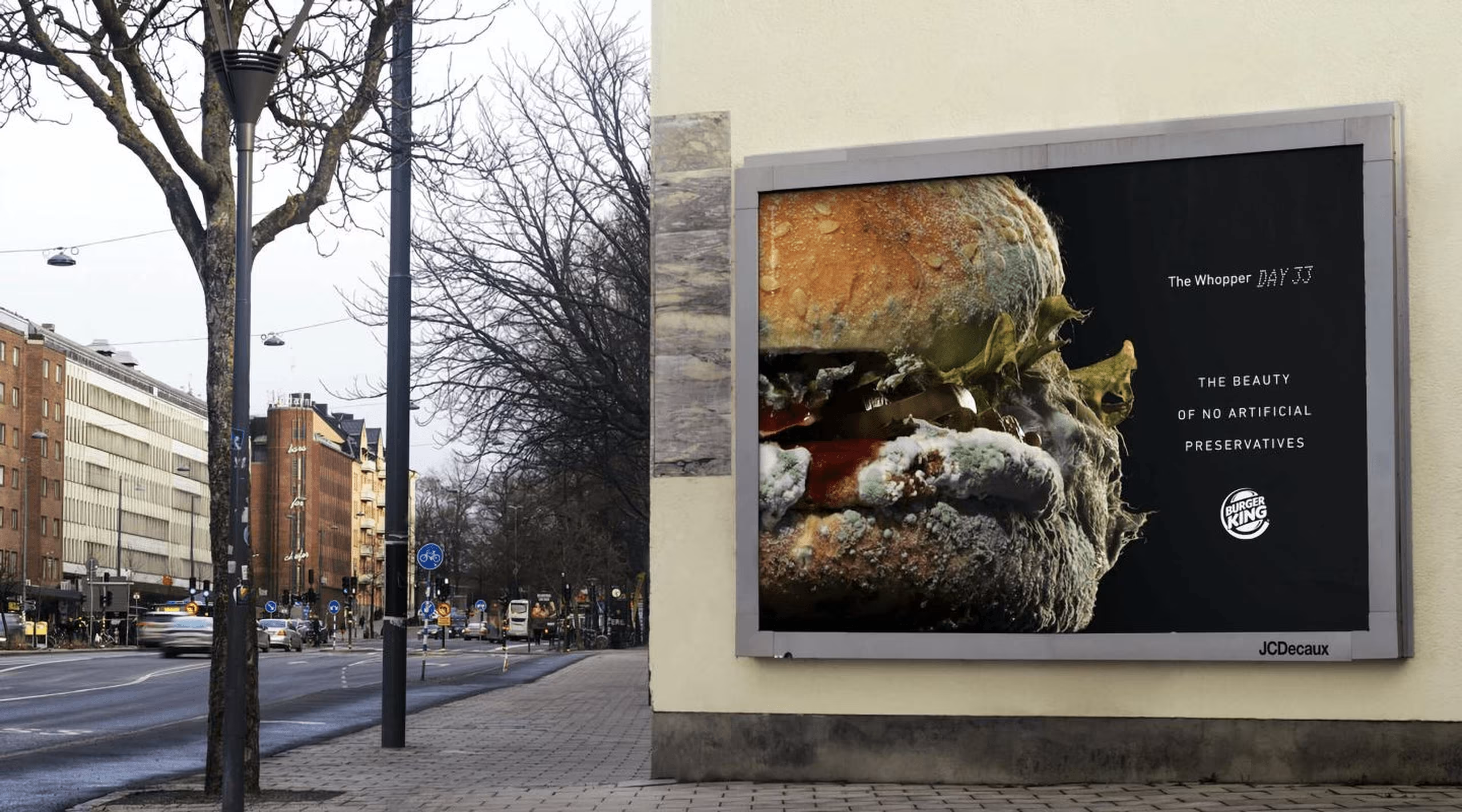
Source: Burger King, INGO Stockholm, DAVID Miami, and Publicis, “The Moldy Whopper,” 2020.
The “Creative Platform” Concept
What It Is
A core idea that’s big enough to support several different campaigns—not just individual implementations. Each campaign can take a different angle while still staying true to the core, so it feels fresh every time. When executed correctly, an idea of this magnitude can work for several years.
The Trap
Treat it like a campaign-ready idea with a larger budget. A platform must consistently generate new campaigns year after year without seeming worn out or repetitive. If you scale it too small, you’ll stifle an idea that could have had potential for an entire decade.
The Test
Ask yourself: “Would this still make sense in five years—even if built around a completely different campaign?” If the core truth holds up no matter how broadly you look at it, then it’s a platform idea.
Example: Snickers, “You’re not you when you’re hungry”
The idea is based on a simple human truth: Hunger changes who you are. Snickers dramatizes this anew every time by transforming someone beyond recognition—a diva, a slob, a grandma—only for them to return to their true selves the moment they eat a Snickers. That’s exactly what distinguishes a platform idea from a campaign idea. It’s flexibly expandable: swap out the celebrity, swap out the format, swap out the decade—and the insight still works.
Source: Snickers (Mars), BBDO New York, “The Brady Bunch,” 2015.
Source: Snickers (Mars), BBDO New York, “Game,” 2010.
Source: Snickers (Mars), T&Pm London, “You’re Not You When You’re Hungry” (Viking commercial featuring José Mourinho), 2025.
Too much to take in all at once? We’ve built a tool for that!
We realize that the different sizes, traps, and tests can be confusing at first—that’s why we developed the Idea Sizer Tool.
It’s an interactive quiz that helps you figure out what kind of idea you’re dealing with—or what kind you should brief—before you commit. The questions lead to one of five outcomes: No idea yet, One-off, Campaignable, Creative Platform, or Platform briefed as a one-off—which means the idea is bigger than the brief you’re giving it.
Once you know the scope, you’re ready to write your actual briefing. However, even a well-defined idea is still just a better idea to test. A creative’s gut feeling only takes us so far, and the idea we fall in love with isn’t always the one that actually performs well—Sophie explains this in the next part of this blog post.
You can’t predict winners
Every untested idea is a bet on an opinion—and opinions are costly when they’re wrong. Without testing, you’re optimizing for what people in the meeting room think will work.
The numbers clearly speak against this approach. According to Motion (2026), only 10 to 20% of creative tests show a statistically significant uplift—meaning most ideas don’t clearly outperform what they’re being tested against.
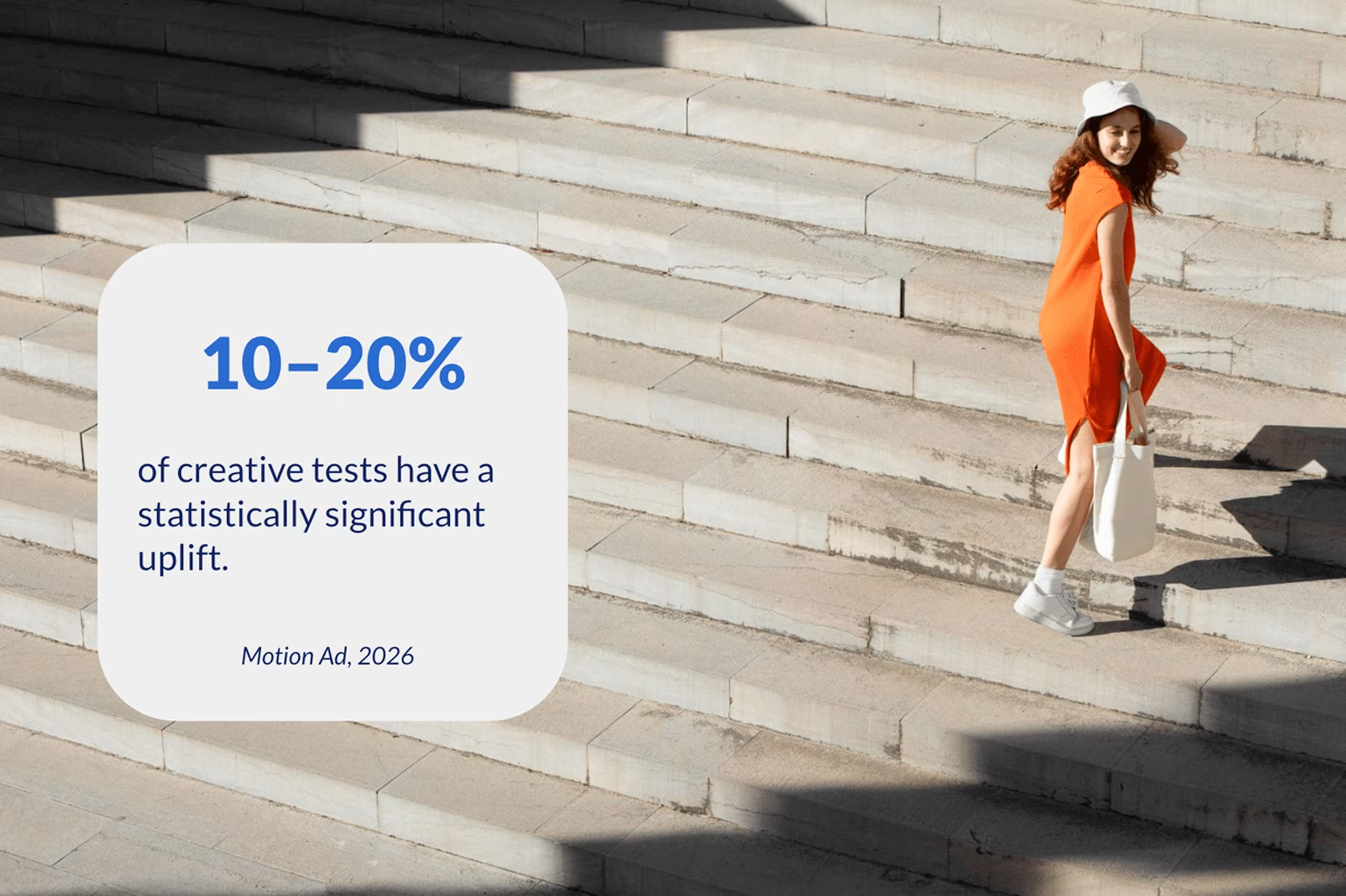
Image: e-dialog
And we’re not good at identifying the ideas that do—not even the so-called “experts.” In a study by Prizmad (2026), marketers were asked to select the actual top performer from a set of five creatives. Only in 1 out of 6 cases (approx. 17%) did they correctly identify the winning creative. Statistically speaking, these experts’ “gut feelings” are no better than pure guesswork (which would also yield a success rate of 20%).

Image: e-dialog
Here’s the uncomfortable truth: You can’t predict winners based on gut feelings. But there is a good way to identify successful ideas: Upskillist (2025) reports that companies that use A/B testing grow their revenue 1.5 to 2 times faster than those that don’t. The only way to find out what works for your specific account, your target audience, and your offering is to test it.
What a Good Test Needs
A test strategy answers three questions before anything is even produced: which channels, which assets, and how long the test is expected to run. The target confidence level and the test duration are determined and calculated in advance—not decided on the day a particular variant happens to be in the lead.
Four rules ensure that the results remain reliable:
-
01
Before you start, define what constitutes a win.
Choose the metric that aligns with your goal. In the first test below, the hook rate and cost per conversion moved in opposite directions—it must be clear what ultimately matters.
-
02
Compare like with like.
The same target audience, the same budget, the same time frame—so the creative is the only difference.
-
03
Run the test.
Stopping as soon as one variant takes the lead leads to statistical noise being mistaken for a real winner.
-
04
Analyze the loser as well.
Even a “losing” variant can still provide insights—for example, about what you should test next.
Creative A/B tests are a powerful tool for boosting your performance. e-dialog is also a certified Google Test and Experiment Partner, which includes geo-experiments, incremental tests, and conversion lift studies.
Two Tests: One Loser, One Winner
Two real-world customer cases help illustrate the topic even better. In each case, a new creative idea was tested. Both of the following ideas were bold and based on a clear insight. Only the A/B test could show us which one worked.
Case #1 – Supplemental Dental Insurance: The Idea That Stopped People from Scrolling, But Didn’t Sell
The Briefing
Product: Supplemental Dental Insurance
Target Audience: Adults & Families
Country: Germany
Platform: Social
Our insight was that fear is one of the main reasons people avoid going to the dentist—and that the mere sight of drills and dental chairs triggers this fear, which is why people just keep scrolling. This flight response kills any willingness to buy.
The Idea
The real villain is the dental bill, not the dental chair. The central idea was: “So the bill doesn’t hurt.” No dental chairs, no drills, no white coats. Instead, a stylized, Wes Anderson-inspired look to break through the feed, paired with the very human panic of opening the bill. One of the taglines used was: “Afraid of the dentist? Just wait until it’s time to pay!”
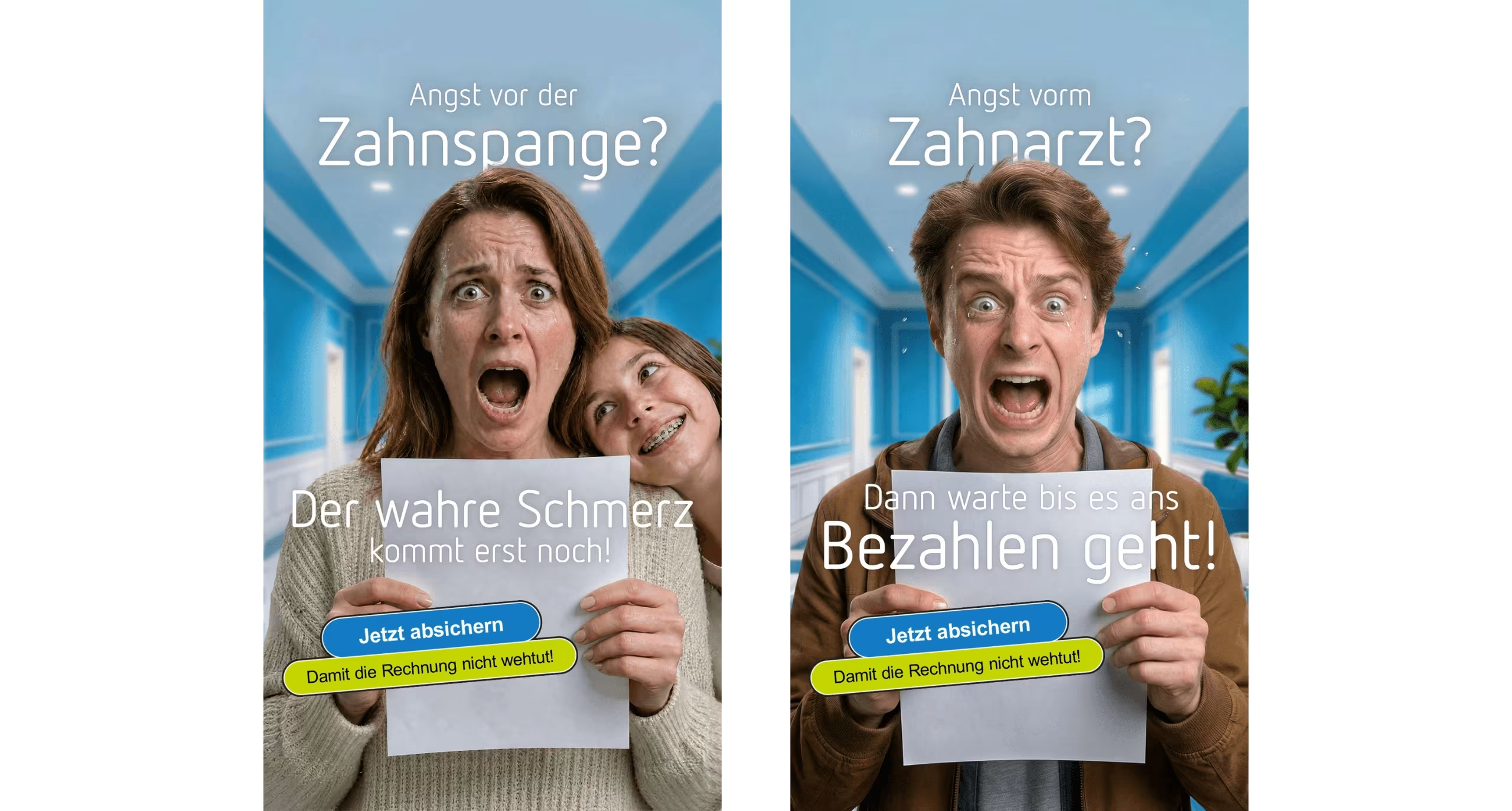
Images & Videos: e-dialog, generated using AI
We tested this idea against a benefit-oriented ad that directly highlighted the offer: “Dental bill: €0.”
Left side: new campaign idea | Right side: old campaign idea
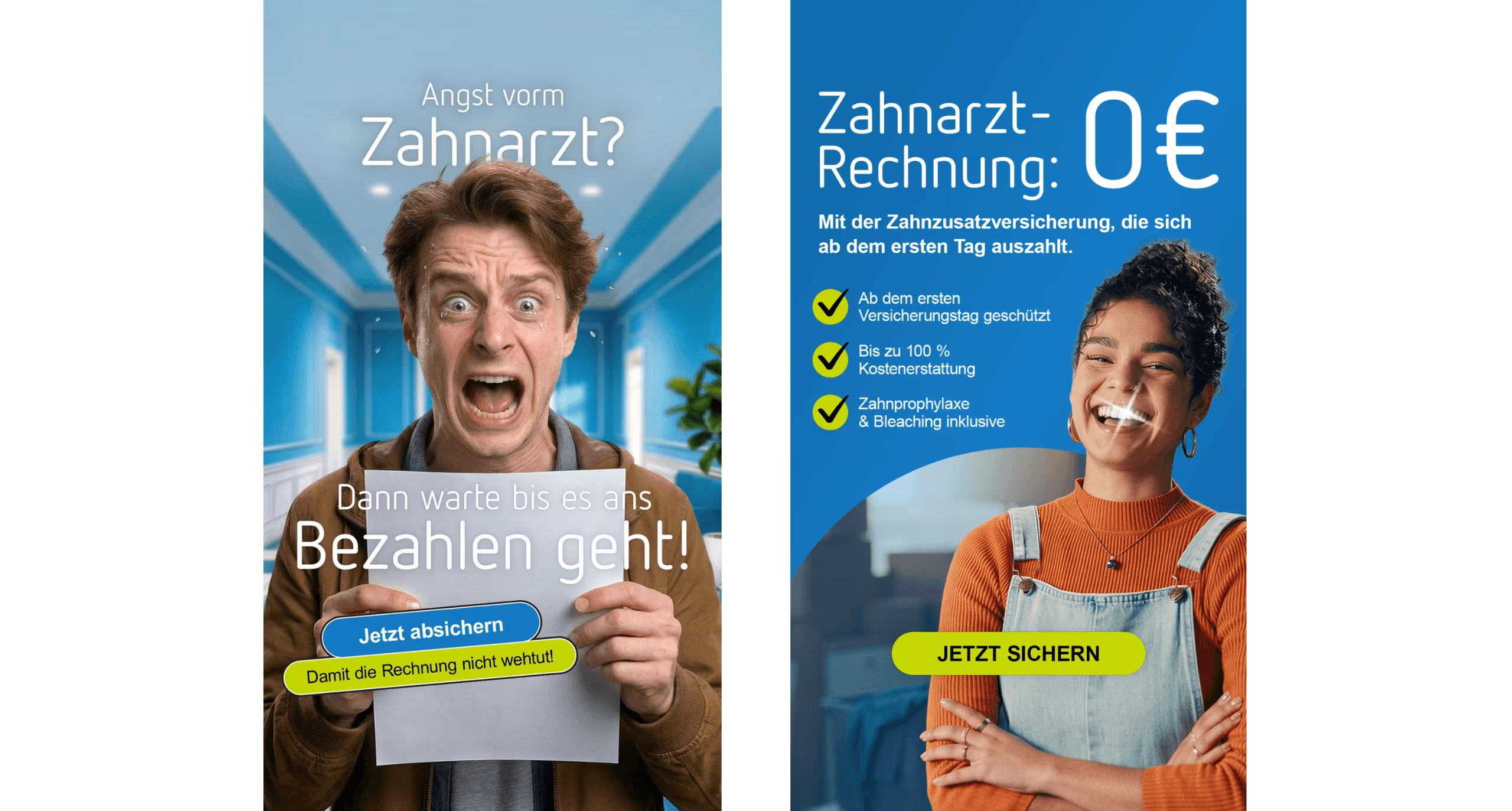
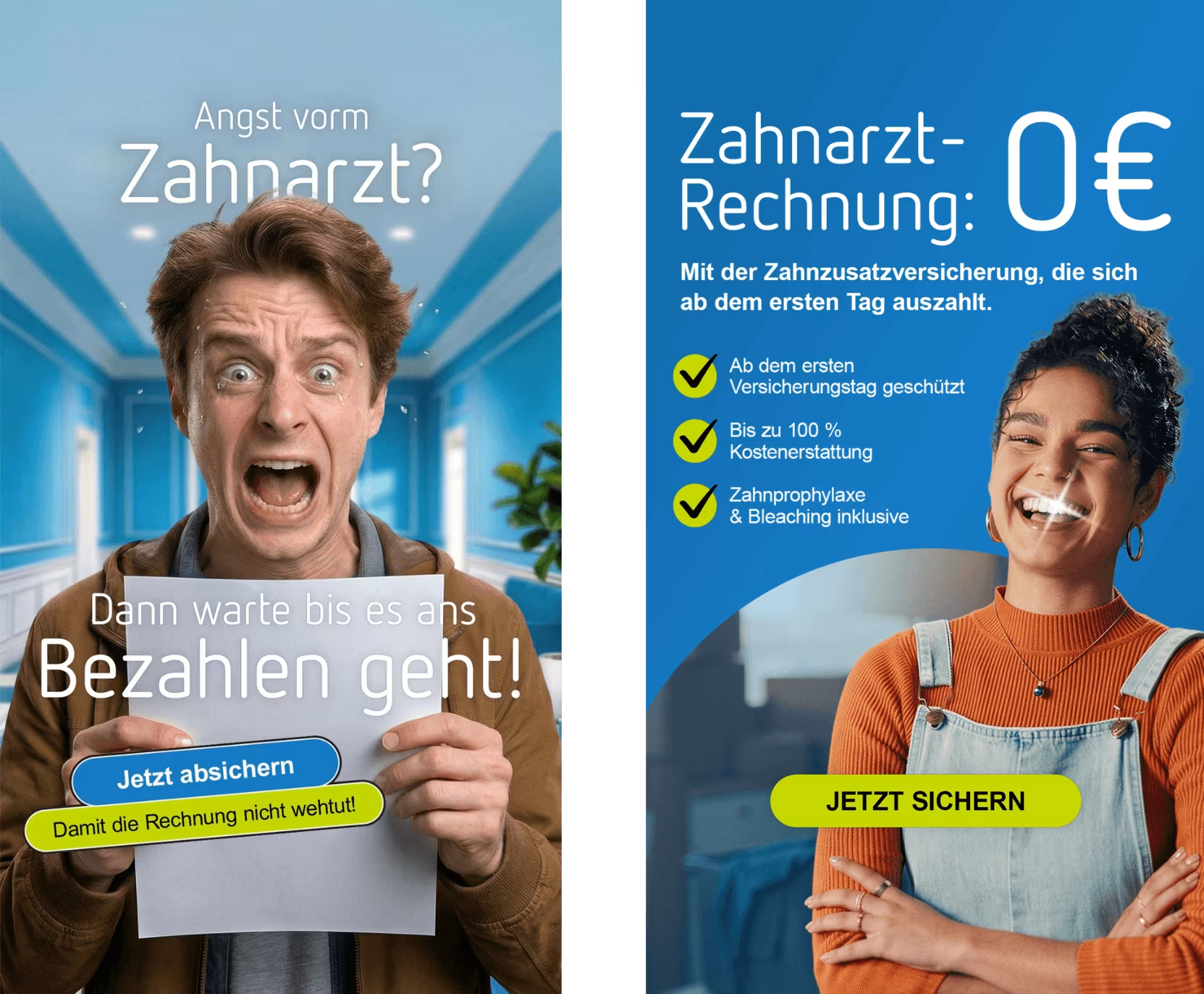
Images: Comparison of the new campaign idea (left) and the old campaign idea (right), Source: e-dialog, generated using AI
The Results
- % Hook rate
- % Cost per click
- % Cost per landing page view
- % Cost per conversion
The concept more than doubled the hook rate, which initially looked promising. However, a look at other KPIs—such as cost per landing page view and the key KPI, cost per conversion—showed that these, too, had more than doubled.
Our conclusion on this case
More attention, less performance. We loved this idea—but the data spoke against it.
This led to three insights: Not every idea works, because target audiences and products differ. Through testing, we discovered this instead of simply implementing the concept blindly. And the data provided direct input for a follow-up test: a strong hook combined with a benefit communicated early on.
Case #2 – Family Hotel: From Chaos to Calm
The Briefing
Product: Winter Vacation
Target Audience: Families
Country: Switzerland
Platform: Social
Our insight was that late fall and winter are particularly stressful for families: little time outdoors, kids with too much energy, and a calendar full of commitments.
The
“
”
idea
, “From Chaos to Calm,” begins with a situation everyone recognizes: a couple on the sofa, a child in the background, accompanied by the caption “Sound familiar?”
The concept then presents a family vacation as the solution—a vacation that caters to the children’s needs and gives parents time to catch their breath. The ads summed it up in just a few words: “More play. Less stress.” and “Family vacation stress? Not with us.”
Video: e-dialog
-
 Example – Implementation of the New Campaign Idea
-
 Example – Implementation of the New Campaign Idea
-
 Example – Implementation of the Old Campaign Idea
Images: Comparison of the new campaign concept vs. the old campaign concept, Source: Meili Selection Hotels
- % Conversion rate landing page views
- % Cost per landing page view
- % Conversion rate transactions
- % Cost per transaction
Our conclusion on this case
This time, the concept outperformed the control group on all four metrics. We used the same method as in the first case, but the results were the opposite. The test variant showed a significant improvement, so we were able to launch this new campaign idea with full confidence.
The Seven Steps to Success
In summary, the quality of ideas and A/B testing form a cycle:
-
01
Determine the scope of the idea.
One-off, Campaignable, or Creative Platform. The Idea Sizer helps you decide.
-
02
Write a good briefing.
One that clearly specifies the required size.
-
03
Develop the idea.
And do so in the chosen size—not the one that’s easiest to produce.
-
04
Create the A/B test concept.
Channels, assets, and a pre-calculated duration.
-
05
Produce the assets.
For each variant in the test.
-
06
Conduct the A/B test.
Let it run for its full calculated duration.
-
07
Make a decision based on the data.
Did the idea perform better? Make your decision based on the numbers, not on who loves the idea the most. And then repeat the process 🙂
Our takeaway: First scale the idea, then test
it
Bold creativity and smart A/B testing work best together. Here are three things to keep in mind:
- Don’t underestimate the impact. A good creative idea can be a real performance booster. In the test for the family hotel, the cost per transaction for the winning concept was 70% lower.
- Size matters. Make sure your idea is the right size before the briefing—otherwise, you’ll end up artificially stretching a one-off concept or trimming a platform down to size.
- Better safe than sorry. Don’t rely on gut feelings—test your ideas instead.
Your gut feeling gets you to the idea—and data takes you further.
So remember: