MMM for everyone? Meridian comes to Google Analytics!

Management Summary
Google Analytics 360 is increasingly developing into a one stop shop for media planning and performance analyses – based on MMM-like statistics. With the latest updates, Google is bringing functionalities for cross-channel media and budget planning, as well as performance forecasting, directly into the tool.
What do the new integrations in GA360 mean?
Previously, merging cost and performance data from various platforms was often a manual or tool-intensive process. The new update fundamentally changes this:
- Native Connections: Integrations launched at the end of 2025 for Meta, TikTok, Pinterest, Reddit, Snapchat and more will become highly relevant.
- Historical Data: There is now a seamless and automated integration for Impressions, Clicks & Cost Data for the previous 2 years.
- Offline Channels: Offline channel data can also be imported.
By importing this data, you gain the reason to have Non-Google Impressions, Clicks and Cost in GA360, which is the reporting of Sessions & Key Events. This allows for a clean, unified view of metrics like Cost-per-Session or ROAS across different platforms directly alongside your website data. These would still be impacted by GA360’s click-attribution, but would drastically reduce manual efforts to aggregate data of different sources.
While we at e-dialog had predicted that these data integrations would constitute the basis for MMM-like functions – we see exactly this happening now.
As an agency we get similar questions each year:
- How much marketing budget is needed?
- How do we allocate the marketing budget?
- Can we measure what impact awareness and branding measures have?
Without MMM these questions are a nightmare to answer. In advertising tools, forecasts scream for more money, the attribution says that each channel is working incredibly well and GA360’s attribution only shows good figures for click-based channels like SEA, Shopping etc.
By integrating Meridian like modelings and insights, answering the above questions will be much more feasible and GA360 become the marketing measurement power house it always strived to be. How do we answer these questions in the near future?
The GA360 Scenario Planner for Cross-Channel Budgeting
The most exciting new feature is the Scenario Planner. It is designed to optimize your Marketing Budget by allowing you to evaluate your Monthly/Quarterly/Yearly Budget for your Primary Channel Grouping. Just this can already answer two of the above questions on how to set budgets. Besides optimizing the marketing budgets, the scenario planner also allows players to play around with budgets to see how a lower/higher budget would impact overall CPA/ROAS per channel in your channel grouping.
This last bit also allows to break down the performance of channels that have performed poorly with the click-attribution as it is entirely modeled – like awareness or offline measures.
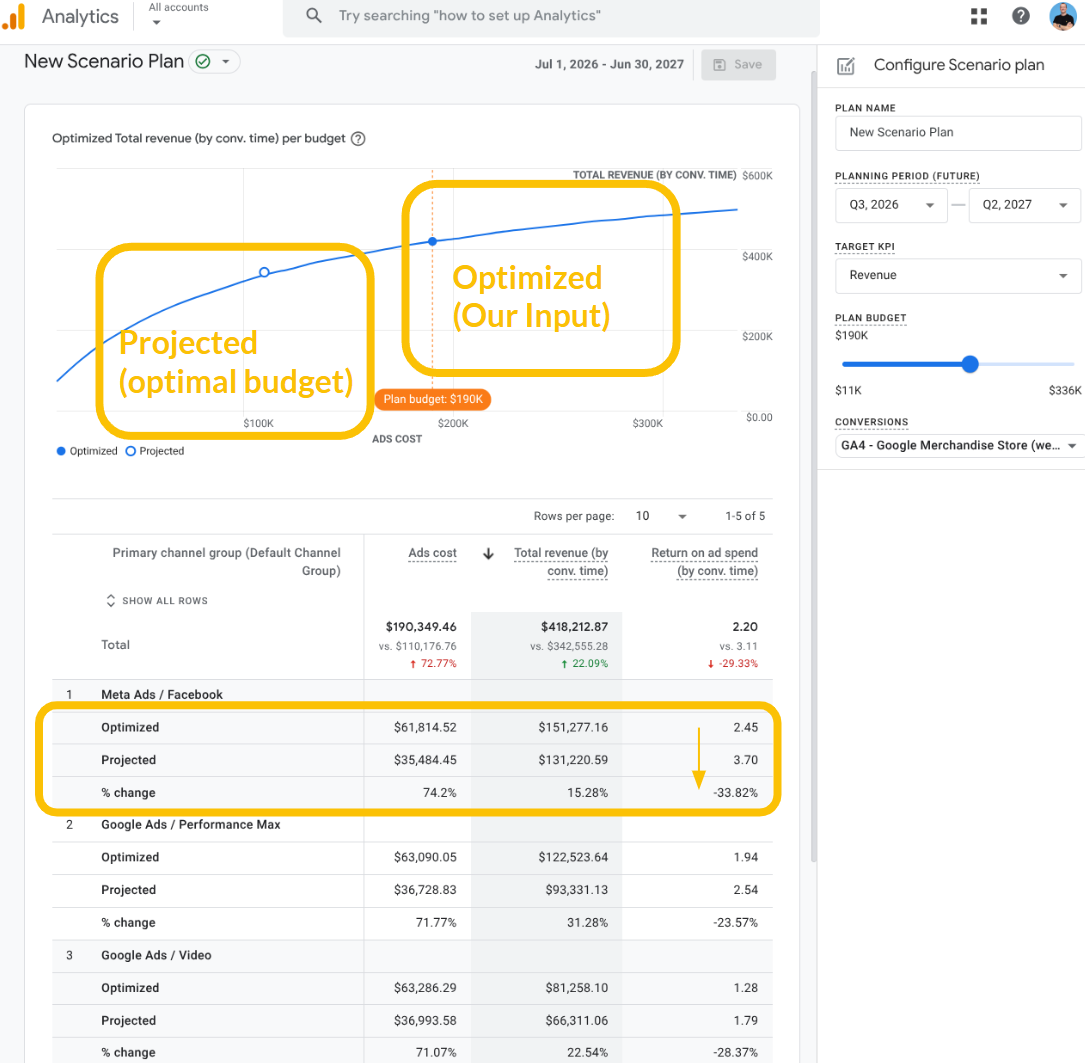
Screenshot: An example of a Scenario report in Google Analytics 360: While the optimal budget for the selected time frame is projected to be most efficient with 110.176$ we put in our budget of 190.000$ and can see that this additional budget is less efficient and ROAS decreases substantially (by 33.82%). Source: e-dialog
Currently these modeling functions are still being developed and alphas. We can expect the roll out of Meridian functionalities to be greater than scenario and projection reports we see today. At the Google Analytics Conference in 2026, further details were discussed that allow us to get a glimpse of what’s coming:
- GA360 will use the click-attribution figures as priors (a starting point) for the modeling but it is intended that these priors can be adjusted by users in the future.
- The Google Search Volume will be integrated as control variables for demand changes for an advertiser’s brand and category, just like in real Meridian projects. This integration helps to correct the inflated SEA and Shopping Performance and also captures seasonality changes.
How does it work? What is different about this?
Meridian – and MMM in general are based on regressions. Regressions are a statistical term for the causal relationship between variables. If a simple regression figures out the relationship between one input (like Facebook spend) and your sales, Marketing Mix Modeling (MMM) takes that exact same math and applies it to all your inputs at the same time.
It looks at your spend across every single channel – like Google, Meta, TikTok, and even offline ads – alongside outside factors like seasonality or holidays. By looking at how all these different inputs interact, MMM untangles the messy web of your marketing to show you exactly which specific channel deserves the credit for your final output (sales), telling you exactly where your budget is working the hardest. While in the past, MMM were therefore only pursued by larger companies and corporations, this direct integration also allows small to medium advertisers to gain access to these substantial MMM insights.
Prerequisites: It’s Not Plug-and-Play
However, the magic doesn’t happen entirely on its own. For the digital connection to work and the model to be accurate, some technical homework must be done:
- Consistent UTMs: A consistent UTM structure is required. You must use a single unique value for utm_medium, and a single unique utm_source value for each publisher platform. In discussions with Google at the Analytics Conference in Vienna, 2026 it was acknowledged that in times of Artificial Intelligence, aligning previous unanimous utm parameters should be possible. If this feature will come is, however, unclear. For now, having a clear utm structure is therefore recommended.
- Currency Alignment: The currency of the connected non-Google data sources matches GA360 otherwise a work-around through e.g. Google Sheets needs to be used.
- Key Events: If not already done, a conversion (or key event) needs to be defined.
- Channel Grouping: If not already done, prepare your channel grouping in a way that it would allow the granularity you would need for your performance evaluation. We suggest e.g. to split Social Media into the different platforms and Search into Brand/Generic.
- Google Ads Link: Make sure your Google Ads Account is linked to your GA360 Property.
- 1- 2 years of KPI & cost: The model needs at least 1 year of conversion/revenue data and cost from your Google and non-Google sources. The model does not know if the data it has is complete. Make sure all channels are connected to achieve reliable results. Up to two years of data can be used for model training.
- (optional) offline Channel: Prepare offline channel data (like e.g. TV or radio) to be able to upload it into GA360. Instead of monthly data, try to break it down further.
Summary, Outlook and Critique:
We at e-dialog expect these functionalities to be rolled out much further in GA360 to e.g. allow for side-to-side comparisons of Attribution vs. Modeling. This most exciting update for Google Analytics makes MMM insights available to a very broad audience and gives it major advantages over its free version and other website analytic tools. Also, while Google’s Meridian is an open-source MMM and therefore transparent, this platform-native modeling should be taken with a grain of salt. Self-contained models naturally tend to favor their own ecosystem and setting independent priors and testing incrementality will be essential to counteract potential platform-bias.