The EU AI Act Is Coming: Here’s How to Stay on the Safe Side with Your Ad Campaigns!

Management Summary
The use of AI in advertising production has long been the norm. Now, the European Union is following suit with the world’s first comprehensive AI regulation. But what does this mean for your campaigns? How significant will the impact be on your creative content on Meta, TikTok, and other platforms?
With our guide, you’ll be well-equipped to assess the impact of the EU AI Act on your paid social campaigns and ensure your setup complies with the law. By using smart workflows and the right labeling, you can avoid penalties and continue to scale your ad performance seamlessly.
What exactly is the EU AI Act, and who in the performance marketing industry will be affected by the law?
The EU AI Act is the world’s first comprehensive legislative framework regulating the use of artificial intelligence. It classifies AI systems into different risk categories: ranging from minimal risk to unacceptable practices that are completely prohibited.
Transparency requirements primarily apply to the performance marketing and advertising industries. Specifically, the law applies to all parties that create AI-generated content and publish it within the European Union. Whether you work at a small performance marketing agency or head the in-house marketing department of a corporation, if you use AI tools for your creative content, you’re subject to these requirements.
EU AI Act: When and Which Advertising Materials Do You Need to Label?
The golden rule from Section 50 of the AI Act is: As a user (advertiser), you are required to clearly label so-called deepfakes (i.e., AI-generated or manipulated content that bears a deceptive resemblance to real people, places, or events) as artificially created. For completely synthetic content (e.g., artificial backgrounds with no real-world reference), the responsibility for labeling in the metadata primarily lies with the AI providers (e.g., Midjourney), but social media platforms often still require you to label such content. The labeling should be clearly visible and distinguishable no later than the moment a person first encounters the deepfake or the published text.
Specifically, this applies to the following formats in your ads:
- Images & Videos: AI-generated models (e.g., Midjourney), artificial backgrounds, or synthetic product renderings must be labeled.
- Audio: AI-generated voices (voice clones, such as ElevenLabs) in Reels, TikToks, or audio ads are also subject to the disclosure requirement.
- Text: The EU AI Act provides some relief for advertisers when it comes to AI-generated text (ad copy). According to the law, the strict labeling requirements primarily apply to texts that provide information on matters of public interest (e.g., news). Ordinary advertising copy is generally not covered by these requirements.
Important:
Exceptions include minor edits such as simple color corrections, standard filters, or retouching, which are industry standard anyway and do not substantially alter the content.
A Comparison of Social Media Platforms: How Meta, TikTok, and Others Handle AI Labeling
The EU AI Act applies in addition to all platform-specific rules, regardless of what the respective network requires. However, platforms implement the requirements in very different ways:
Meta (Facebook, Instagram, Threads): Requirement to Display the “AI-info” Label
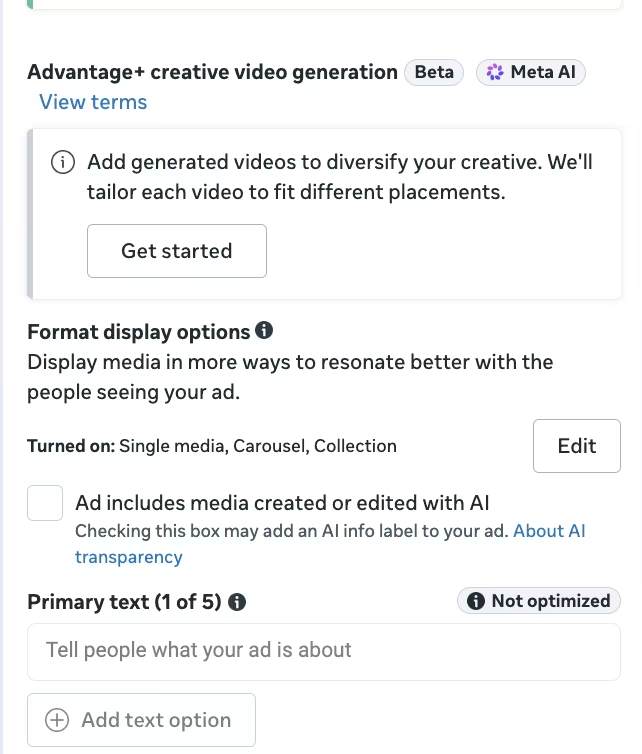
AI labeling has been a mandatory feature in Ads Manager since 2026 and is no longer optional. If Meta’s own Gen-AI tools (such as Advantage+) are used, Meta automatically applies the “AI-info” label itself. If your own AI-generated content is uploaded outside of Advantage+, each variant must be manually marked as AI-generated in Ads Manager. The focus here is on images, video, and audio—plain ad copy is currently exempt from the labeling requirement. In addition, Meta automatically scans uploads for C2PA or IPTC metadata (e.g., from Midjourney, DALL·E). If such metadata is detected, Meta automatically applies a non-removable “Made with AI” label. Violations (e.g., tampering with the metadata) may result in the ad being rejected or a label being enforced.
Image: Checkbox in Meta Ads Manager, Source: e-dialog

Image: Labeling AI-generated ads at Meta, Source: Meta
TikTok: AI Disclosure Tag for Ads and Product Demos
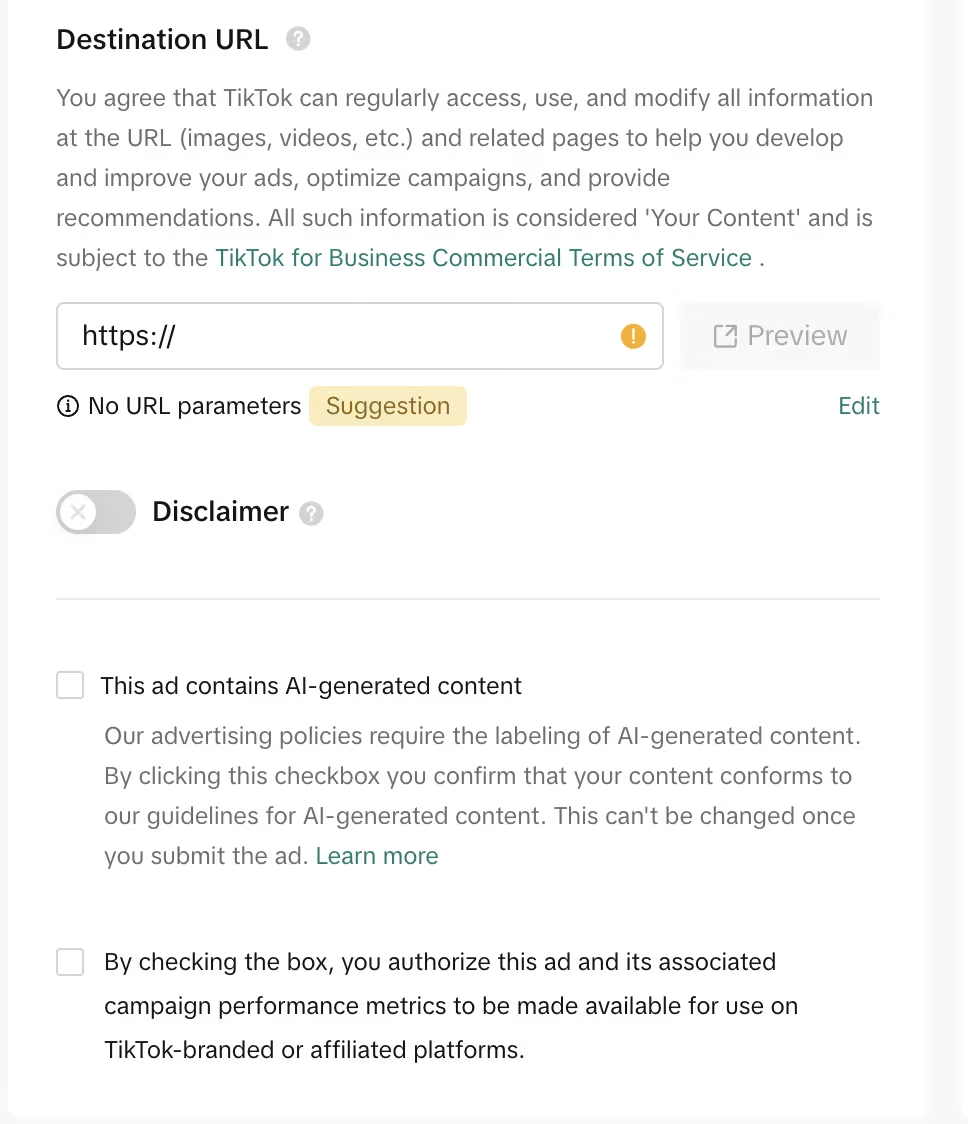
An AI disclosure tag is required for ads on TikTok whenever synthetic faces, voice clones, AI backgrounds, or photorealistic AI product images are used. This also applies to TikTok Shop, where AI-generated product demos or virtual try-ons must be labeled. AI-generated text, on the other hand, is explicitly exempt from the labeling requirement. TikTok combines the mandatory label (AIGC toggle) in Ads Manager with automatic detection via C2PA Content Credentials. A tiered penalty system is in place: warnings for a first violation are followed by escalating measures, up to and including account suspension, as well as a compliance review of all campaigns, if necessary.
Image: AI checkbox for TikTok Ads, Source: e-dialog

Pinterest: Automatic AI Tagging Using Metadata
Currently, there is no manual labeling option in the tool; however, content is automatically labeled using metadata and AI scanners. When a user clicks on an image pin, a label such as “AI modified” or “Gen AI” appears in the detail view. Violations may result in rejection or the imposition of a label.
Image: Gen AI Labels for Pinterest Ads, Source: Pinterest
LinkedIn: Transparency for AI Creatives Through C2PA Content Attribution
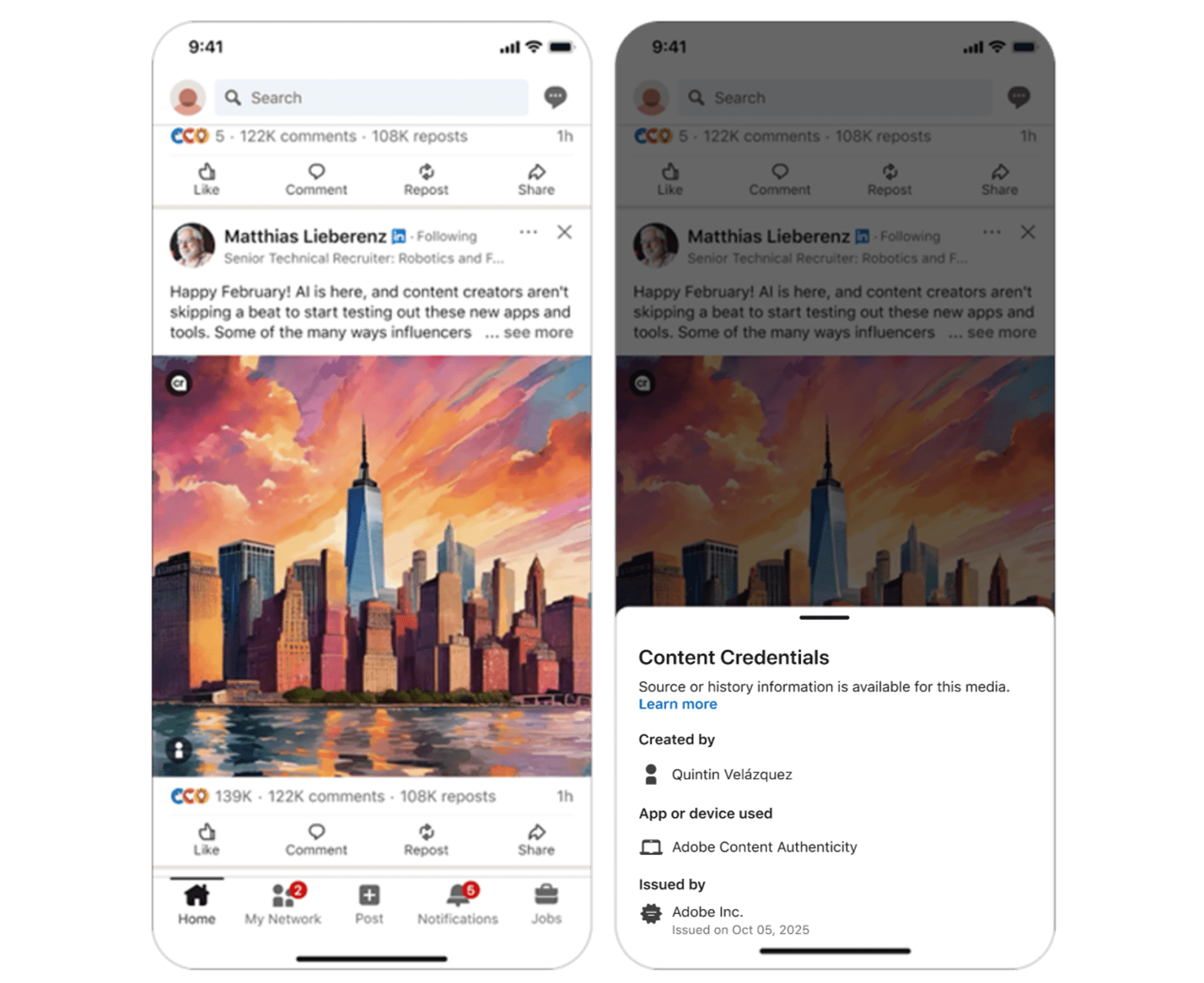
LinkedIn uses the C2PA standard to label AI-generated content. Images and videos that include cryptographic C2PA proofs are automatically marked with a corresponding icon. By clicking on the icon, users can see whether AI was used to create or edit the content and which tool was used.
Image: Labeling of AI-generated content for LinkedIn Ads, Source: LinkedIn
Snapchat & Reddit: Requirement to Include Your Own Label on the Creative
There is currently no confirmed, native AI checkbox directly in Ads Manager on either platform. However, Snapchat’s advertising policies prohibit misleading AI editing. Reddit also explicitly requires the disclosure of synthetic content. Since platform-specific tools are lacking, you must label the content yourself on the creative. If unlabeled AI content is detected, you risk ad rejections, restricted campaigns, and, in the worst case, account suspensions.
X: Content Disclosure via the “Made with AI” Toggle
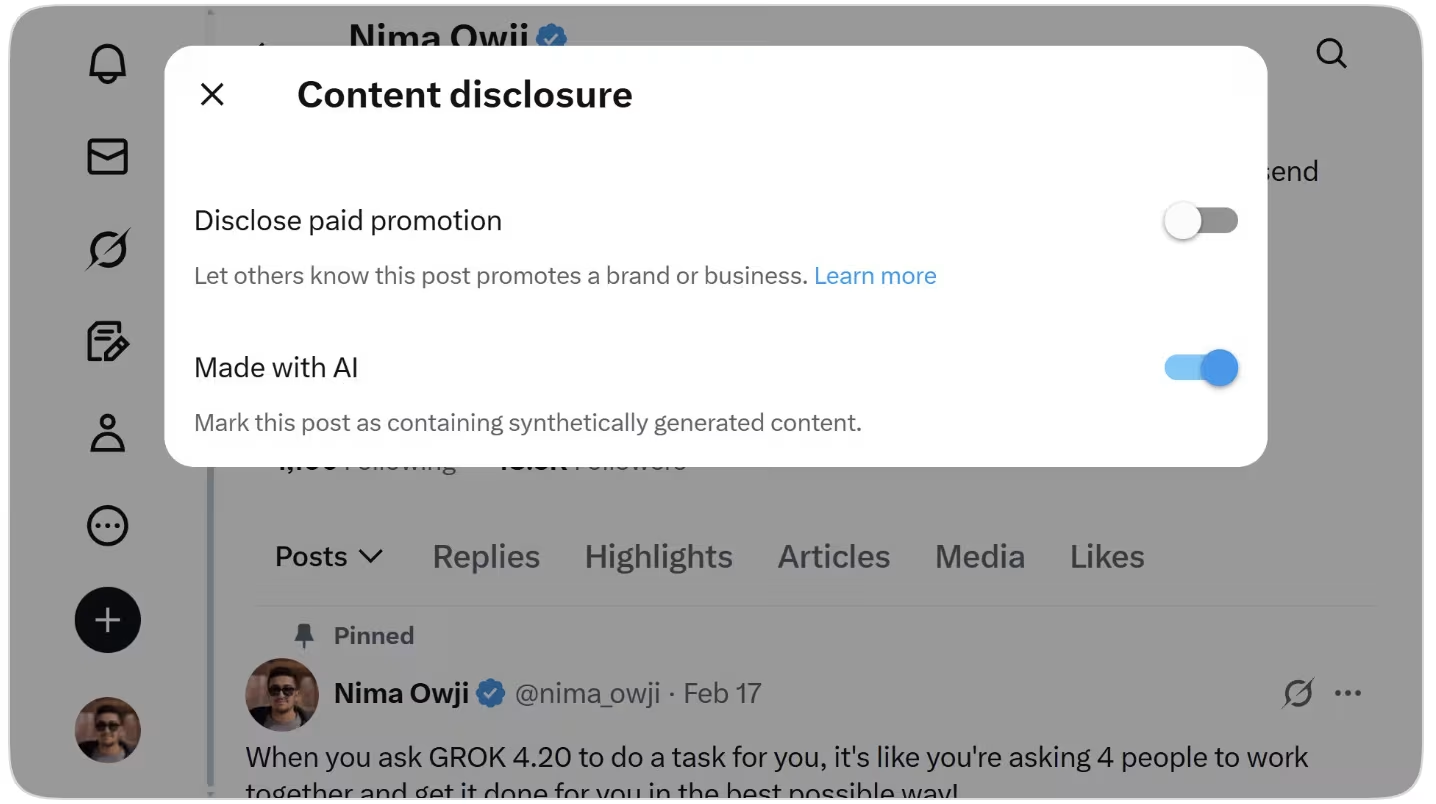
A system-wide “Made with AI” label has been rolled out here. Advertisers and creators must declare AI-generated content when creating posts using a toggle in the “Content Disclosure” menu. An automatic background detection system checks for undeclared synthetic media. Failing to disclose or intentionally circumventing the label is considered a violation of the guidelines. Penalties include the immediate deletion of the post and the immediate suspension of the entire advertising account.
Image: “Made with AI” label for ads on X, Source: X/nima_owji
Beware of the metadata gap
Don’t blindly rely on the platforms to automatically extract C2PA metadata. As soon as you edit an AI-generated image (e.g., in Photoshop), this data is often lost, and you must label it manually.
EU AI Act Compliance: Your 4-Step Plan for Campaign Managers
-
01
Documenting AI Tools in the Creative Stack
First, get a complete overview. Document all the image, video, voice, and copy tools currently in use. Only when you know where AI is involved can you properly label the outputs later.
-
02
Establish a Labeling Workflow
Define clear guidelines for your team in creative and campaign management: When exactly must an AI label be applied? Make sure to note whether AI elements are included during the creative briefing so that the checkbox isn’t overlooked during setup. For platforms where native labeling or automatic scans aren’t yet possible, there’s a simple workaround: Place the disclosure directly and prominently in the ad copy or on the creative. You don’t have to come up with your own watermark for this: The European Commission now offers official, free AI icons for download. There are versions for images generated entirely by AI as well as for partially manipulated content. Simply place these icons in your creatives, and you’ll be on the safe side visually.
-
03
Implement Monthly Checks for Active Ads
Proactively check active ads for correct AI disclosure as part of a regular monthly audit. This applies especially to those platforms that do not yet offer a standardized workflow for labeling.
-
04
Keep Track of Deadlines in 2026
The clock is ticking inexorably: Starting August 2, 2026, the law’s strict transparency requirements will apply to all new AI systems. For existing systems, you have until December 2, 2026. It’s therefore better to set up your new approval workflows sooner rather than later to proactively avoid costly fines running into the millions just before the deadlines expire.
Why Transparency Is Gaining Ground in AI-Generated Content
New laws often sound like a nuisance of bureaucracy. But in the age of deepfakes and artificial sensory overload, trust is the ultimate superpower for brands. An AI label is therefore not a performance killer, but proof of honesty. Those who openly show how they work build an authentic connection with their target audience, and that’s exactly what pays off in strong conversions in the end. So just see the label as an opportunity to position yourself as a modern, reliable brand.
Conclusion: Using AI in Content Creatively and in Compliance with the Law
The EU AI Act will introduce new rules for social media marketing starting in August 2026, but it by no means signals the end of AI in content creation. On the contrary: Those who prepare now—by documenting their tool landscape and establishing smart workflows within their teams—will continue to run high-performing, highly scalable, and legally compliant campaigns. It’s not about doing without the efficiency of AI, but about using it smartly, transparently, and responsibly.