Ga Cdp Google Analytics As Customer Data Platform

Management Summary
We already know what a Customer Data Platform (CDP for short) is and what you need it forthis articleextensively described. A comprehensive differentiation from other systems such as CRM, DWH and Data lakeyou can find it here.
Google Analytics can also be used as a customer data platform:This makes particular sense if you already operate extensively in the “Google” ecosystem and use tools such as Search Ads 360, Display & Uses Video 360, Campaign Manager and Optimize 360 for personalization.
With theUnification of DoubleClick and Google Analytics 360 and the resulting Google Marketing Platform(GMP for short), Google has even increased this step: The big advantage of GMP is definitely the seamless integration of all Google tools.
This results in another, even greater advantage:The integration of all Google data from all Google tools in a single system – namely Google Analytics as a common data stack:
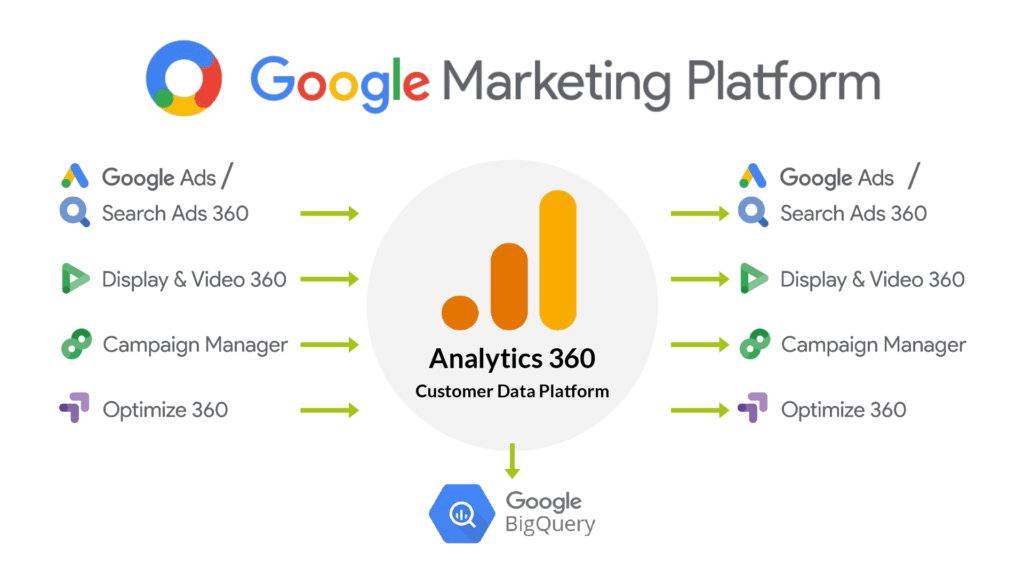
According to Gartner, GA already meets the first requirements for a CDP:“A marketing-driven solution that creates a unified user database”, i.e. brings together and connects data on a user basis (albeit anonymously).
Of course, not only Google data can be recorded in Google Analytics:
Data Consolidation: The Heart of a CDP
Finally, for a 360° view of the customer journey, ALL campaign data from ALL marketing channels (both online and offline) must be integrated into Analytics.
There are different ways to do this:
1) Online:Online, campaign data is primarily collected via campaign parameters in Google Analytics. So-called UTM parameters are attached to every campaign or campaign URL that is located outside of the Google world.
This means that GA not only knows which campaign the user came to the website through, but also automatically via which channel.
In addition, visual contacts should also be recorded without clicks. → This works via the Campaign Manager & GA360.
2) Offline:Additional data from CRM and other systems can be integrated into GA via data upload or the measurement protocol. This means that offline data such as transactions from the POS to data from the IoT area is also recorded in Google Analytics.
Clean campaign management including a tagging strategy is the basis for the success of a CDP with Google Analytics.
The more correct view of Google Analytics as CDP is therefore this:
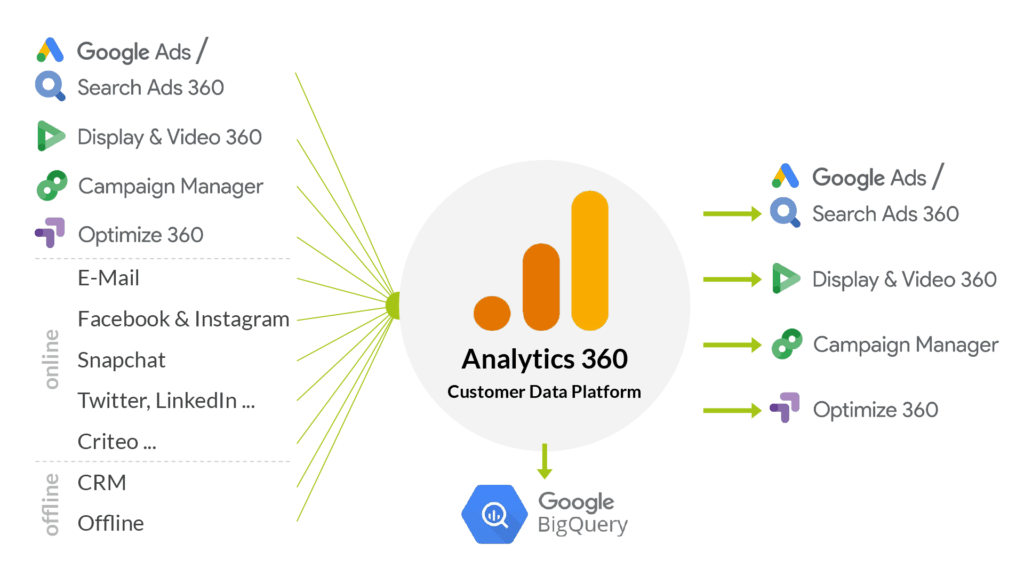
According to Gartner, Google Analytics therefore also fulfills the main task of a CDP: NamelyCleanly connect ALL company-wide data sources across ALL channels.
And that is also the great potential and goal of CDPs:
Segmentation: The A&O for the right customer approach
From this common data source, visitor segments can now be created for cross-channel segmentation strategies.Keyword: audience management.
This means: Customers are identified who are grouped together based on various characteristics and trigger signals in order to then address them across channels with the right message at the right time.
Google Analytics also has a decisive advantage here: Segments are the basis for creating an audience in Analytics – and segments are and have always been a basic function in GA.
Anyone who knows Google knows how simple, convenient, user-friendly and at the same time powerful the segment builder in GA works:

Figure 3: Creating segments in Google Analytics
However, if the already extensive segment engine of Google Analytics is not enough for you, you can really have fun with SQL in BigQuery:
[Excursus] Even more complex segments with BigQuery
BigQuery (BQ for short) is a Google Developers tool, which enables extremely fast queries on large data sets.
The huge advantage in the 360 world is definitely the seamless connection of Google Analytics 360 with BigQuery:This means that the GA data can be AUTOMATICALLY exported and queried daily in BQ – on a raw data basis (!).
But the highlight is definitely the use of BigQuery as a segment builder for even more complex visitor segments: For example, segments can be defined for loyal customers who came to the website via Facebook or Instagram and had more than 5 orders in the last 6 months and a shopping cart between X and Y euros (and… and… and).
Such complex queries are hardly possible using the segment builder in GA – but can be queried in just a few seconds in BQ.
Back to Google Analytics as CDP…
Status quo: Google and the rest of the world
What’s still missing is the step out of the Google world to also create audiences for email, Facebook & Co usable, because these are currently standard in many companiestwo marketing platformsin use:The GMP in the Google world and another marketing automation softwarelike emarsys, Hubspot or ExactTargetfor “the rest”.
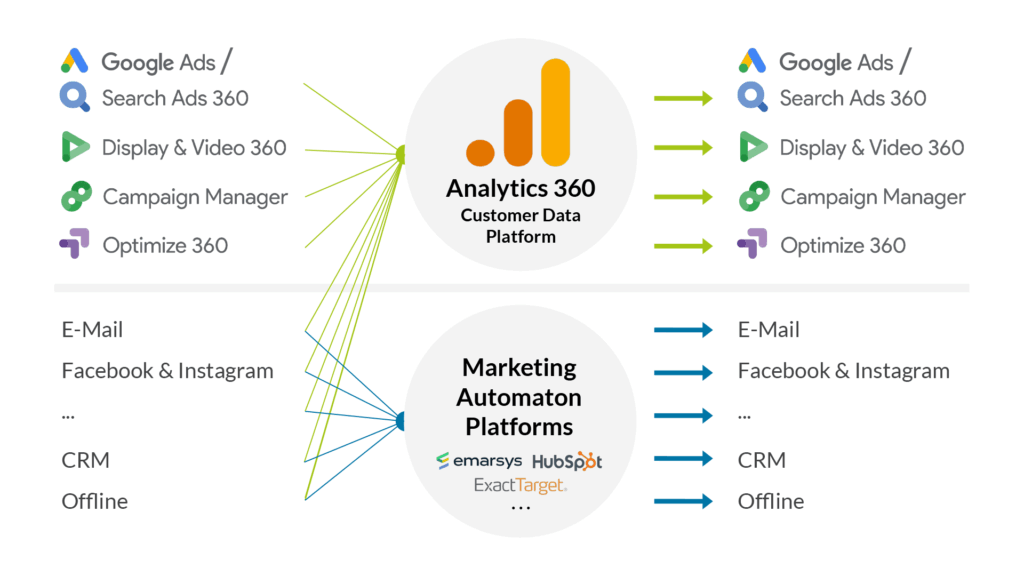
Of course, that’s not exactly advantageous.
1) The whole thing is usually outrageously expensive.
2) The whole thing is extremely complex! Because most marketing automation tools use their own tracking pixels and NOT the Google Analytics data that has already been recorded.
That means:
- Double tracking.
- Double effort.
- And two huge data silos between Google and the rest of the world…
No satisfactory solution… That’s why new solutions have to come into play and we’ll introduce you to four of them here:
- Solution #1: Salesforce and Google Analytics
- Solution #2: Search Ads 360 Audience Sharing
- Solution #3: Custom Matching&Sync Script
- Solution #4: Enterprise CDPs with GA as part of it
Solution #1: Salesforce and Google Analytics as a dream team
Since Google and Salesforce became strategic partners, the two world-leading systems for CRM and digital marketing can communicate seamlessly with each other.(>> See details here.)
This is of course brilliant, because it means you can stay in your existing tool world and reap all the benefits from it.
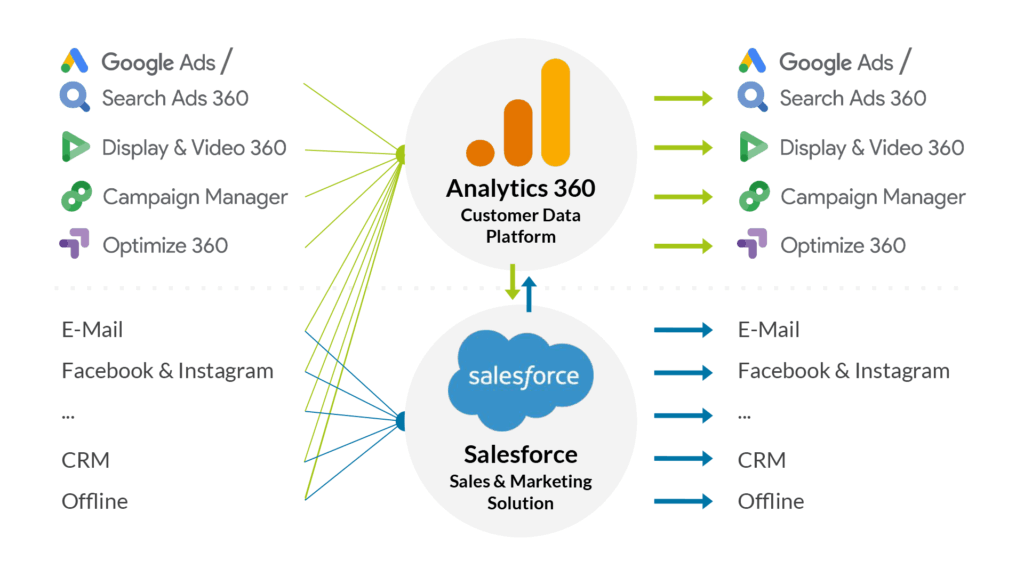
The only disadvantage: The CDP idea is lost here because audience management takes place in both GA and SF. To counteract this, SF recentlydatoramabought. Datorama is a proprietary CDP solution that will be integrated into SF in the next few weeks and months. In the future, SF will be the customer data platform and Goole Analytics will expand it to include website data.
But, not everyone is blessed with Salesforce…
Solution #2: Search Ads 360 Audience Sharing
Google understands that an isolated Google World is NOT ideal.
With tools like Smartly.io or 4C Insights, audiences from Search Ads 360 (which in turn can be based on Google Analytics segments) can be used for remarketing in Facebook and Instagram.
There is also a Twitter link with 4C Insights.
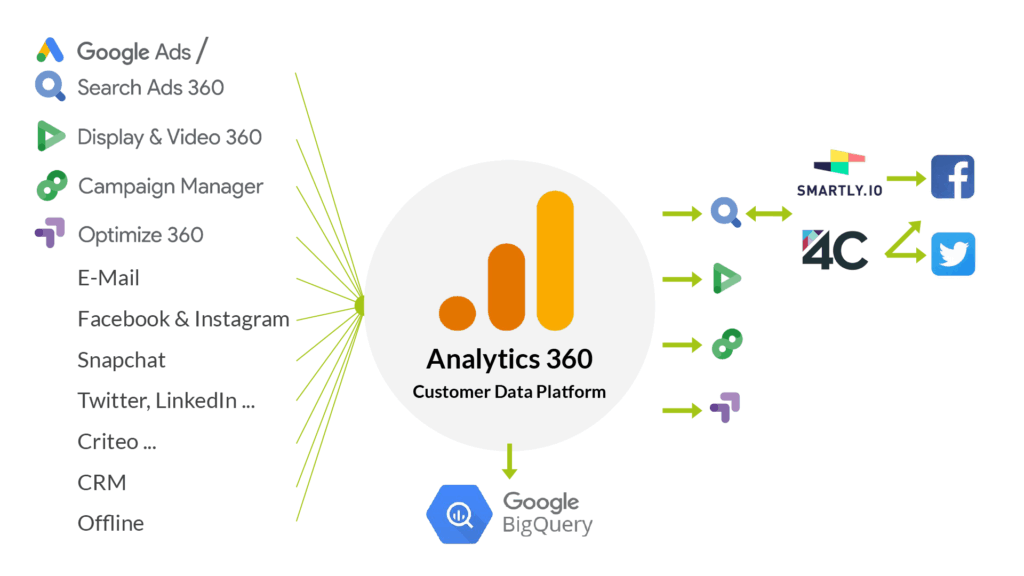
The advantage is that the Facebook campaign data flows into Search Ads 360 and can be used for analysis, reporting and campaign optimization as well as for attribution.
So there are no longer two separate views for search and social, but rather a common basis and a common conversion tracking system.
This is an excellent basis and is completely sufficient in most cases. But… there’s a lot more than just Facebook and Twitter. That’s why a custom solution comes into play as a third option.
Solution #3: Custom Matching&Sync Script
So we need a connector, a simple tool that sends the GA audiences to exactly the channels used in the company: Is Mailchimp used as the email tool? Then you need a Mailchimp Connector! Campaigns are played out on Facebook, Twitter and LinkedIn? Then you need a Facebook, Twitter and LinkedIn connector!
The interfaces to these tools are open: Just like emarsys, Hubspot, Salesforce & Using these open interfaces, simple, customized matching & Sync Tool to access these and make the GA Audiences available in the channels used – just without any fuss:
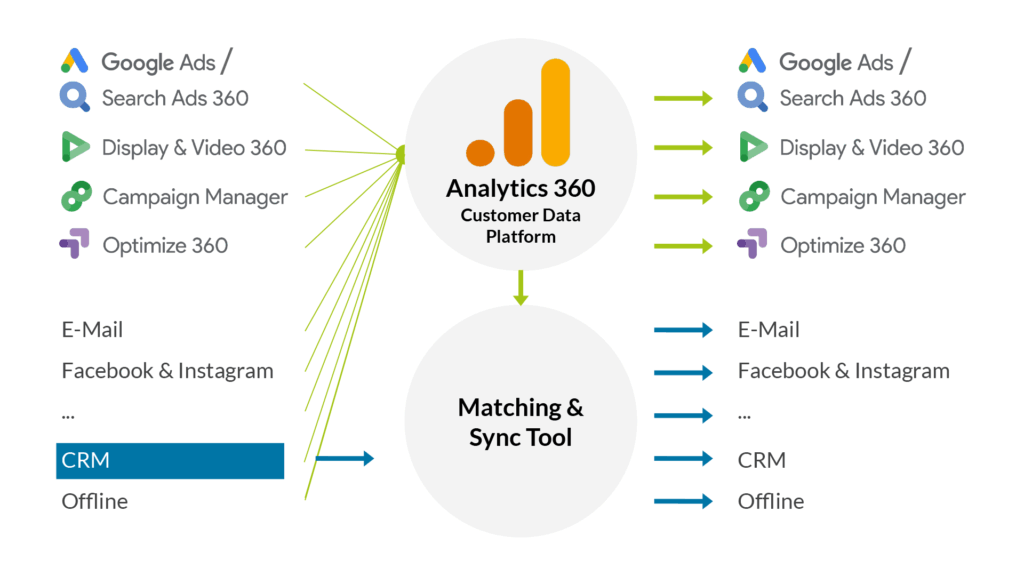
In principle you only need three things:
- The Google Analytics data including UserID as a custom dimension.
- The CRM data, as Google Analytics is only allowed to store anonymized customer data – the matching in Facebook & Co but usually based on the email address.
- And an automatic interface connection to the marketing tools used in the company (usually not 500 but 3-7).
A notice:Not only within the framework of the General Data Protection Regulation (GDPR) and with regard to the upcoming e-privacy regulation, there are strict regulations for website operators and advertisers, which can be complied with in accordance with the law with central user consent management.>> More about that here.
The advantages of the Matching & Sync tool:
- No double tracking(i.e. no additional effort) because the data is accessed by GA.
- No data silos, as these are resolved via the Matching & Sync Tool.
- Just a marketing platform,instead of two (or more), namely in GA.
- All data combined in one CDP, namely GA.
Only disadvantage:
- A bit of implementation effort
Last:
Solution #4: Enterprise CDPs with GA as part of it
An alternative and completely different approach are tools such as Tealium, Commanders Act or Crossengage, which act as a CDP.
These tools also unify ALL customer data into a “single source of truth” and make it usable across ALL channels, ALL technologies, ALL customer touchpoints and ALL teams.
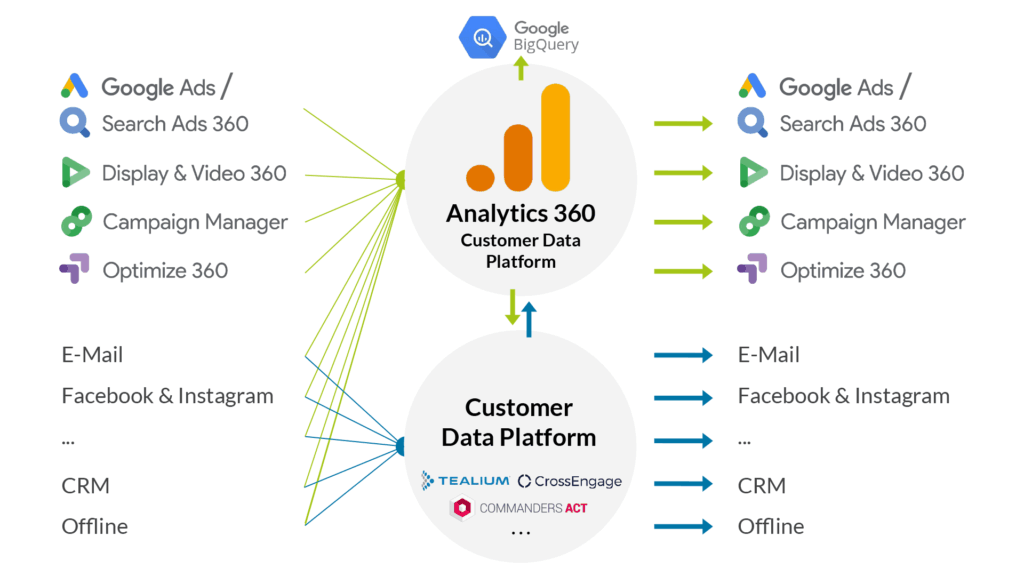
The most important thing is:Enterprise CDPs do NOT replace existing corporate tools and platforms, but rather function as middleware, similar to the custom solution. Only difference: Tealium & Co are the CDP and Google Analytics is the marketing platform. So here everyone works to their own strengths.
In order to enjoy ALL the advantages from “both worlds”, Google Analytics supports and supplements the in-house CDP with the data from Google World.
Conclusion: Google Analytics as CDP
Google Analytics is predestined to be used as a customer data platform – in a variety of ways. A different solution makes sense – and is possible – for every company size, for every requirement and for every use case. So GA is very flexible here and offers us different approaches so that we can get the most out of the data.