Not Provided 8211 What Can We Do Seos
Management Summary
(not provided), (not provided), (not provided)! Can we still report and analyze SEO’s?
And whether!There has been a lively discussion on this topic recently and countless articles have been written that do not offer us readers any solutions and do not really help us in our daily business.
The sudden switch to the https protocol is being questioned not only in the SEO or web analysis scene, but also in Mountain View. Yes, Google itself is also questioning your sudden switch.
Hopefully the following lines will give you an example of what is (not provided) and what tools can be used so that you can access data that will really help you!
Analysis and optimization – Without organic keywords?
In order to be able to analyze our pages – and optimize them based on these results – Google provides us with tools such as Google Webmaster Tools or Google Analytics. But due to Google’s change not to provide keyword data, Google is contradicting itself extremely in data analysis and – as the saying goes – is shooting itself in the foot and hitting us SEOs in the organic keyword stomach.
Fictional effects of (not provided) in the offline world
Let’s take a real-life example: You open a retail shop for a large sporting goods manufacturer on a busy street in Vienna. This gives you everything you need to get started. The shop concept, images, advertising material, goods, cash register systems, analysis tools, etc. In principle, you don’t have to worry about much anymore, but you should still report monthly and constantly increase sales. After 2 successful years, you will then be informed that the cash registers and analysis tools will only be taken away on the highly frequented streets in large cities. How would you feel? And, without a cash register, how are you supposed to find out whether my location is still generating strong sales and which goods have sold particularly well? Would you still like to work with this sporting goods manufacturer?
Unfortunately, this is just one example from our – still existing – offline life. However, there is a small but subtle difference between our example and our relationship with Google. We online marketers depend on Google and cannot really exchange our “partner”. Unless you just want to track your Yahoo traffic from now on.
To go back to my title. Of course we can still report! We just have to know how and what we need.
(not provided) solution with Searchmetrics
Not only Google provides data (WMT, Google Analytics, AdWords), but also “non-Google” tools such as Searchmetrics. Searchmetrics comes from the SEO area and recognized this trend very early on. Since the big (not provided) roll out on October 20, 2011, the Berlin team has been working on a solution to externally circumvent the organic data problem. With a keyword database of over 240 million, an incredibly high number of your organic and paid keywords are tracked. From this data, the traffic data is broken down for each keyword.
Here is a small excerpt of the organic traffic analysis from a Searchmetrics project:
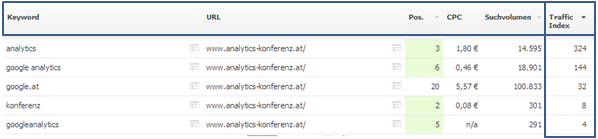
The organic keywords + position + monthly search volume of the previous month + the traffic index are given in detail. And that’s exactly what the traffic index in question is all about. This column shows the likely traffic generated by the respective position per month. In addition, factors such as AdWords ads and Google Places etc. are also included in the probability calculations.
Our conclusion on traffic analysis with Searchmetrics
Searchmetrics are known for their innovative way of working and their continuous optimization work on the tool and – as already mentioned – recognized the (not provided) trend very early. As a result, Searchmetrics has been able to experiment and optimize the existing data for 2 years so that they can also show off the traffic index. For this reason, we also use this data for our reporting, although we would of course expressly point out that these traffic figures are not 100% valid and do not always appear realistic. BUT: It is definitely an alternative!
(not provided) solution with the new Organic Paid Report
Fortunately, we SEOs didn’t have to wait long for a new organic report. Google released a new Organic Paid Report a few weeks ago. My first thought: Oh, maybe we can handle and report our data a little more validly again. As a result, I took a closer look at this report. You can also review this report yourself. Unfortunately, you can only access this data if you are an AdWords customer. Here, too, you can feel that Google wants to bring the organic and paid areas together more and more.
You also need to link your AdWords account with your Google Webmaster Tool. You can find the instructions here: https://support.google.com/adwords/answer/3097241?hl=de
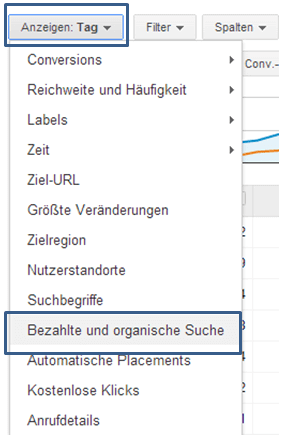
Once you have linked your AdWords account with Google Webmaster Tools, you just have to be patient (approx. 1-2 days) until your data is imported. After successfully linking, you will be able to access the option in your AdWords account“Dimensions” …

on the drop-down menu of the displays on the report“Paid and organic search”.
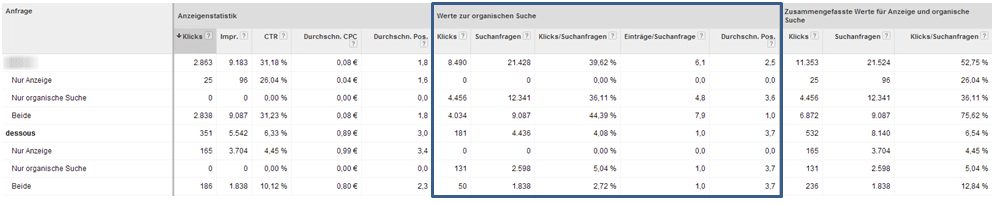
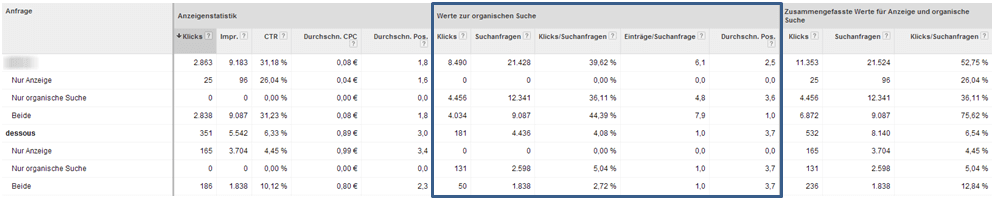
The great thing about this report is that since the release of the Organic Paid Report we have been able to directly compare organic and paid traffic. We also have great data to rely on, such as average position, as well as metrics such as clicks, search queries, clicks/searches, entries/searches. We also get away from the cannibalization between AdWords and SEO that is mentioned again and again. However, please do not try to compare both channels directly. It’s not about the question of AdWords or SEO, but also about the effects on the other channel as well as on social media, affiliates, etc. However, this does not have to mean that this change has positive effects for SEOs, especially since many companies view the data comparison between SEO and AdWords marketing as a contra-SEO, since the AdWords data is of course much more positive than the data from organic search, especially in the rankings. Of course, considering whether you run AdWords ads and how much budget you spend on them.
Our conclusion on traffic analysis with the Organic Paid Report
Google provides us with a rather satisfactory to sufficient alternative. Of course, it’s not particularly positive that “only” AdWords customers can use this report, but in any case we find data that we can work with. In addition, all data can also be exported via CSV, PDF, XML, etc. Unfortunately, the most important metric in my opinion is not tracked or monitored and that is our conversions for certain keywords. To solve this problem, you would have to take a more complicated approach and that would be conversion rate evaluation via your landing pages.
Conversion evaluation via landing pages
If you use the URL rankings from Searchmetrics to compare the keywords ranking for your respective URL with the landing page conversions from Analytics, you can definitely access data that could help you. If you would like to find out more about conversion evaluation via landing pages, simply send us an email directly to seo-team@e-dialog.at. I hope I was able to shed some light on this dark matter and wish you continued good traffic via organic search!
One thing is certain in any case. SEO is and remains relevant!