Targeting In Gdn The Ultimate Guide

Management Summary
Audience targeting vs. contextual targeting
When targeting in the Google Display Network, or GDN for short, we have the choice between audience targeting and contextual targeting. While the former ensures that users are targeted based on their interests, demographic characteristics or search behavior, with the latter we determine on which pages the advertising should be displayed.
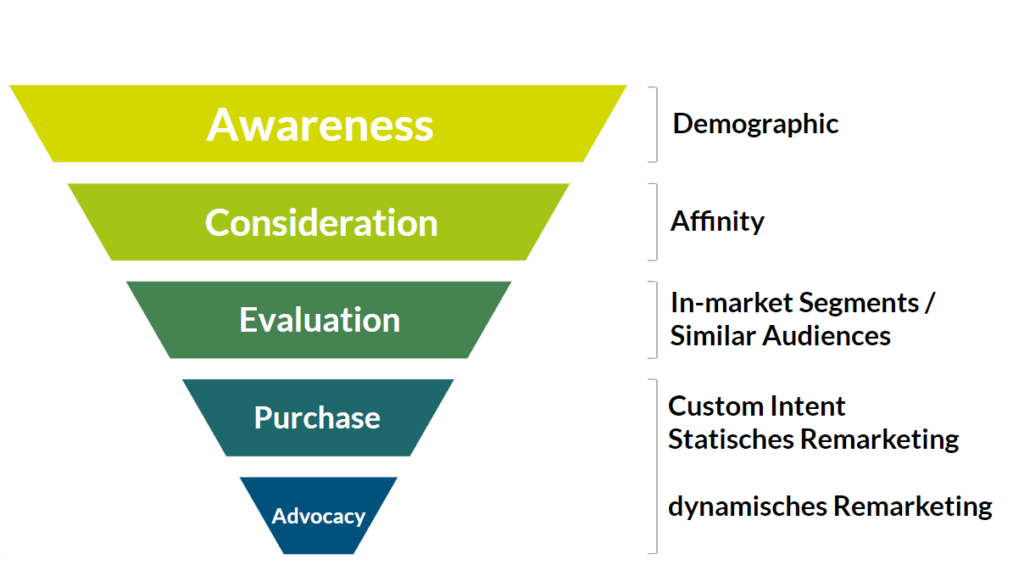
Targeting Audiences
As already mentioned, targeting target groups offers the opportunity to reach users based on, for example, characteristics, interests or search behavior. We will show you the different options you have when defining and selecting your target group and also explain the main differences.
Targeting by demographics
If you ask advertisers who their target group is, you will usually either get the answer that you don’t know or information like “female, between 24-29 years old and single”. While gender and age have long been available, attributes such as relationship status have only recently become selectable among target group characteristics. The new onesdetailed demographic characteristicsHowever, they are currently only available for search network campaigns and can give them a noticeable fine-tuning with appropriate bid adjustments. Other examples of this include parental status or educational status. Household income can also be used for alignment, but this currently only works in selected countries – Germany, Austria and Switzerland are not among them.
Interests and purchasing behavior of the target group
One level deeper in the funnel are the target groups with specific onesinterests. The interest categories offered by Google include, for example, football fans, hardcore gamers or regular visitors to beauty salons.
Is that too generic for you? Would you rather target fans of FC Bayern Munich instead of just football fans? No problem – you can increase the level of personalization even further using custom target groups with common interests. To do this, simply store interests in the form of keyword phrases together with URLs from relevant websites. Location categories such as public places or apps can also be taken into account when creating these target groups.
Ready-to-buy audiences
Withready-to-buy target groups or in-market audiencesGoogle Ads offers the opportunity to reach users who are already actively searching for specific terms. Combined with remarketing, in-market audiences are a powerful tool for driving high-quality traffic to your website. To ensure that users are included in a target group that is ready to buy, Google evaluates clicks on relevant ads as well as subsequent conversions and the content of the websites visited.
Here too, there is an opportunity to further increase the level of personalization through custom intent audiences. Similar to custom interest audiences, you combine multiple targeting factors, in this case search terms and URLs from relevant websites, into one audience. With Custom Intent Audiences you can reach users who are actively looking for your products and services but have not yet been to your website.
Don’t know where to start creating? No problem – Google will automatically create a custom intent audience for you based on existing campaigns and account settings.
Remarketing

Remarketing can be used to specifically target users who have already been to your website. This makes it possible, for example, to specifically remind a user who leaves the website after placing a few products in the shopping cart to complete the purchase. Another possible scenario is to offer complementary products to users who have already purchased.
By the way, remarketing lists can also be created via apps, YouTube or email lists. For the latter, please note that you absolutely need the clear consent of the user.
Similar target groups
Similar target groups or Similar Audiences are formed based on existing remarketing lists. Like the Lookalike Audiences in Facebook Ad Manager, similar target groups are a simple but effective way to generate reach without losing relevance. This type of target group has also been available for search network campaigns for some time now.
Life events
True to the motto “Keywords don’t buy your products – people do.” It wasn’t long ago that Google had the opportunity toLife eventssuch as graduation, wedding or apartment purchase, published. Users who fall into these target groups are recognized based on their current search behavior. In order for this to work, you must be logged in with your Google account. Currently, life events targeting is only available for Gmail campaigns or video campaigns.
Contextual targeting
Unlike target group targeting, the Google system focuses on contextual targeting on content aspects of websites. In this case, the ads are displayed on pages whose content can be assigned to the selectable topic categories or which contain selected keywords. The selection of specific placements (e.g. an entire website, just parts of it or specific apps) is also possible with context targeting.
Topics
With topic-based targeting, you have the opportunity to display ads on pages whose content can be assigned to one of the many selectable topic categories. From agriculture to music to food and drink, just about any topic can be chosen. So if you want to show your ads primarily on websites that, for example, deal with fashion designers or fashion collections, all you have to do is check the corresponding box under the selectable topics.
keywords
An alternative to topic targeting is keyword targeting. For example, if your target group enjoys hiking tours, adding relevant keywords to this topic can ensure that your advertising is displayed on the relevant websites.
Placements
Placements are places on the Display Network where your ads can appear. This can be entire websites or just individual pages. For example, by combining it with the topic of sports, you could limit your advertising to purely sports-relevant pages on derStandard.at.
Application in practice
So which type of targeting is better for achieving your goals? Unfortunately, this question cannot be answered in general terms because the answer depends on the goals in question. Do you want to reach users who have already been to your site and viewed certain products or even added them to their shopping cart without completing the purchase process? Then you are best served with remarketing, ideally in the dynamic version. If you’re pursuing awareness goals, you’ll probably choose Similar Audiences or (Custom) Audiences with Common Interests.
Just like with search network campaigns, a clean structure also contributes significantly to the success of display network campaigns. Therefore, separate your selected targeting variants into separate ad groups or, if necessary, create separate campaigns for them. On the one hand, different targeting options can be assigned to different levels of the customer journey funnel; on the other hand, the combination of interests and keywords, for example, would lead to an intersection of users and thus severely limit your possible reach.
A final important point that we would like to address here is the topic of brand safety. Unfortunately, advertisers may see their ads appear on sites whose content or message is dubious, such as sites with right-wing extremist content. It is therefore extremely important to consistently list these websites and place them under placement exclusions so that future advertising is prevented there.
Conclusion
Admittedly, with all the targeting options, it can take a while to get used to it. Therefore, take plenty of time and remember not to rely on your gut feeling, but to test, test and test again!