Dynamic Facebook Ads 8211 Simply Explained
Management Summary
How do standard link or video ads differ from dynamic ads (also known as dynamic ads or DCO)?
Standard link and video adsuse a fixed ad element per setup: 1 image/video, 1 text, 1 headline, 1 description, 1 CTA is selected individually during setup.
Standard link and video ads include:
- 1 image/video
- 1 text
- 1 heading
- 1 description
- 1 CTA
Areseveral variants of an ad desired, such as different text or image variants, a separate advertisement must be created for each.
This results in some disadvantages:As the number of components to be tested increases, the number of displays increases and so does the effort required to create the setup. Since the traffic is spread across many advertisements per ad group, the data basis for optimization can become too small. In the worst case, this means that the algorithm does not work optimally when testing the ads.
How do dynamic creatives work and how do they stand out from standard advertisements?
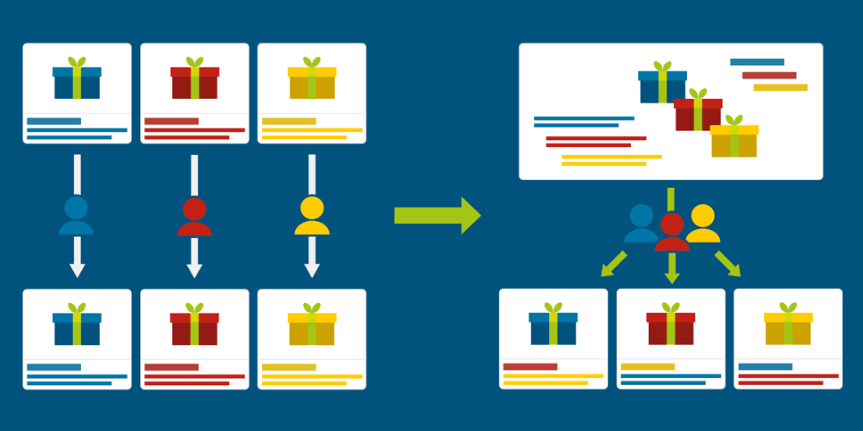
With dynamic Facebook ads, individual elements such as images, videos, text, headlines, descriptions or calls to action are individually combined. The system is based on machine learning and an algorithm decides which ads are shown to whom. After a learning phase, the system evaluates the performance and delivers the best combinations of ad elements to the appropriate target group –“Matching the right creativity to the right audiences”.
Dynamic Creatives Hard Facts:
- Dynamic combination of ad assets such as image, video, text, headline, description and call to action
- Five variants can be stored in each case. This results in 30 possible ad variations.
- System is based on machine learning
- Algorithm decides who gets which ads
What is the goal of Dynamic Creatives?
The user and his needs are the focus of dynamic ads. The “best performing combination” of the ads for the respective target group is determined and displayed accordingly (see graphic above).
A key advantage of dynamic creatives based on machine learning is that they achieve promising and valid results even with short campaign durations!
Who are dynamic ads suitable for and what are their advantages?
Testing
Dynamic displays are particularly suitable for testing. If advertisers have many assets at their disposal, they provide clarity about which advertising medium is best suited for which target group. Another practical testing case would be to use dynamic creatives to find out for which target group which image material is more suitable. An example: Which of my target groups is more of a cat type and which is a dog type?
Few assets
Even advertisers with few assets have a clear advantage with Dynamic Creatives: Where initially material was available for only 1-2 advertisements (e.g. due to little available image material), dynamic Facebook ads now offer the possibility of multiplying them in no time by using multiple CTAs, different texts, descriptions and titles.
Little time resources
Creating ads and testing them can take a lot of time and effort. What ads are created? Which elements are tested against each other? Which variants make sense? With Dynamic Creatives, a large number of different advertisements are created with little effort and time and the testing is 100% carried out by the algorithm.
Performance-oriented campaigns
Dynamic creatives are particularly suitable for performance-oriented campaigns.
What should you pay attention to during setup?
Dynamic Facebook ads are created in Ads Manager. However, the creation of dynamic creatives is only possible to a limited extent via the campaign goals Conversion, App Installs and Traffic.

E-commerce practical case
In practice, we were able to achieve the following results by using dynamic ad combinations for one of our e-commerce customers:
- Very cost effective!In direct comparison to dynamic product ads – also called Dynamic Product Ads or DPA – which are highly recommended if you focus on remarketing and acquiring new customers – this was the caseThe cost per order of Dynamic Ads is half, while the number of conversions has almost doubled!
- Compared to DPA, theAd Frequencyat Dynamic Adsreduced by 25%and theReturn on ad spendin totalcan be increased by 123%.
- What theTarget groupsaffects (also when focusing on generating new customers): especially with oneRelatively open target group targeting, dynamic ads achieved by far the most conversions.The more specific the target groups were, for example targeting value-based lookalike audiences of buyers, the more conversions were achieved via DPAs.
This shows that it is still important to test which advertising medium performs optimally for which target group in which phase of the purchasing process.
Our conclusion
- Target groups on social media channels are very fast-moving and interests change frequently. The focus here is clearly on testing, for which dynamic ads are ideal.
- Dynamic Ads create clarity about the needs of target groups! Vague assumptions about which advertising media or in which combination are likely to bring better results from a performance perspective for the target groups are history.
- No more time-consuming manual setups! Automated creation allows for up to 30 ads per ad group.
- If you want to increase your conversions and reduce overall costs, you should definitely add dynamic ads to your social campaign to see the benefits and results for yourself.