Facebook Campaign Performance Booster More Success With Less Complexity

Management Summary
Anyone who works in the paid social performance cosmos knows that the underlying target group of a campaign is essential. At the end of the day, you want to reach the right people with a message or, for example, a product and use the available media budget as efficiently as possible.
Depending on how established a brand is, you know your target group very well, or perhaps not at all. In any case, in addition to a funnel concept, you had (or should) have a potential target group in mind. Keyword: personas. Here the emphasis is on had, because this often results in more complex and, above all, very granular campaign structures. But is that still contemporary? The answer is – no.
Wind (or hurricane) of change aka. iOS 14
Online marketing thrives on further development and is shaped by short or long-term trends. Some of these are not so pleasant for advertisers, especially the iOS 14 rollout since 2021. With this update, the data basis as we knew it in paid social advertising has changed massively. Meta counteracts the whole thing and has introduced a framework with Aggregated Event Measurement, whereby signals are at least partially aggregated, delayed or even limited to the Ads Manager. But the bottom line issignificantly less dataavailable, which is clearly reflected in campaign performance and reporting. The narrower the target groups and the more granular a setup, the more challenging it is to get a campaign running and you ultimately lose performance. Remarketing campaigns are significantly affected by this, but the effects can also be felt in the New Audience area. In view of the coming post-cookie era, the situation here will certainly not improve.
In order to maximize its potential, it is important to give the algorithm enough leeway. Away from oversteering towardsautomation. In principle it works very simply: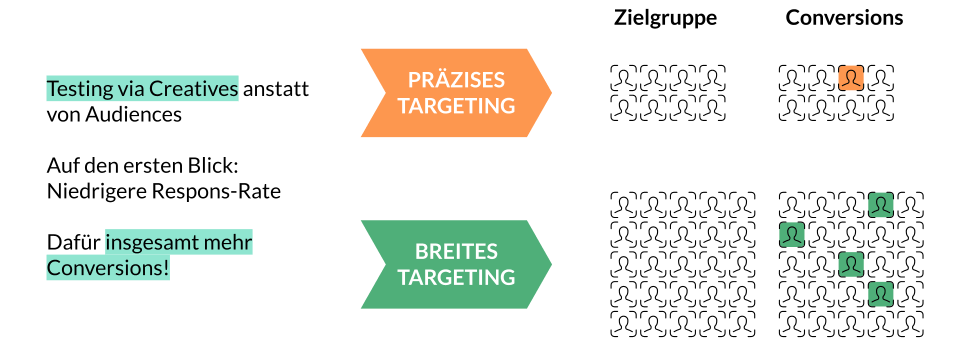 Source: e-dialogue
Personas vs. ad relevance
In the spirit of best practice, people often worked from a predefined target group to the creative or ad: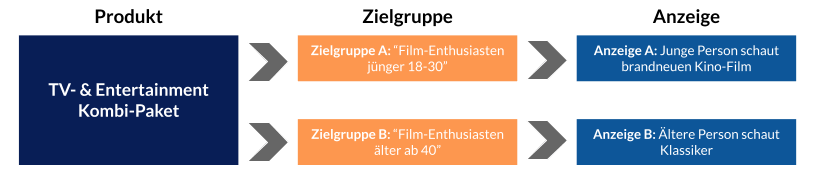 Source: e-dialogue
The example given above is of course very simplified; it is only intended to demonstrate the common approach of a target group setup. Basically, however, you don’t know whether target group A would really prefer Creative A or vice versa. It is also immaterial.
What is important, however, is the relevance of an ad – message and content. The first step is to think about the USP of a product, the resulting benefits for users, the objectives and, above all, the message of a campaign as a brand. Depending on the case and story, different ad formats are suitable, ranging from 1:1 video to reels to stills. The classic funnel thinking regarding formats can be completely ignored here. The bottom line of these considerations is that testing in the future will not be based on targeting but rather on creatives. By testing formats and content, you get to know your target group and their requirements bit by bit. It sounds extremely plausible, but it is not often practiced in practice.
Long story short: Thinking in personas is out and limits campaign performance. The focus should be on creating an ad or creative that optimally meets the brand’s objectives and, at the same time, the associated needs of the users.
Campaign Setup 2.0
What can a modern setup look like? As described above, the leverage lies in the approach: moving away from the well-known funnel and target group thinking, target groups are grouped together thematically in larger pools (e.g. according to need, step in the customer journey, awareness level, etc.) – instead of a granular setup. This avoids categorizations that are often based on assumptions but not valid data. This allows the creative to automatically find the right audience. The campaign framework itself remains much simpler. In addition, with manageable campaign structures, target group overlaps can also be more easily controlled and avoided.
Advantages at a glance:
- More conversions
- More effective use of budget
- More flexible ad design (e.g. via DCO)
- Simple testing scenario
- Know-How: Which messages/promotions are well received by the target group
Conclusion:
2021 has brought some changes. The available data base in paid social advertising has become thinner and requires new perspectives and methods to assess the performance of a campaign. It is therefore advisable to not only change your way of thinking in terms of data interpretation, but also to take a new path in the setup, because creatives or ads will or already are the key to targeting and one of the most essential levers in optimization.