Maximum Impact With Google Ads Your Short Practice Oriented Audit Guide

Management Summary
In this comprehensive guide, you’ll learn how to conduct an effective Google Ads audit to optimize your campaign performance and make the most of your advertising budget.
Step 1: Clearly define goals
Before taking a closer look at the account, one thing is very important: start by setting precise goals for your campaigns. Do you want to get more traffic to your website, increase sales or increase brand awareness?
Once your goals have been determined, it is crucial that conversion tracking is implemented correctly and adapted to your goals. This allows you to accurately measure and evaluate the effectiveness of your campaigns.
Step 2: Review campaign structure
A well-thought-out structure is the foundation of successful Google Ads campaigns. Review your account structure
Do you still have an overview of your account structure or are your campaigns hopelessly overloaded?
Google Ads is known to be constantly evolving. Keyword match types are adjusted, new ad formats and new campaign types are added regularly. Of course, this also has a lasting impact on the account structure. For example, a structure that was created 5 years ago might no longer comply with Google best practices today. In order to keep an overview and achieve the best results, it is essential to regularly review the account structure.
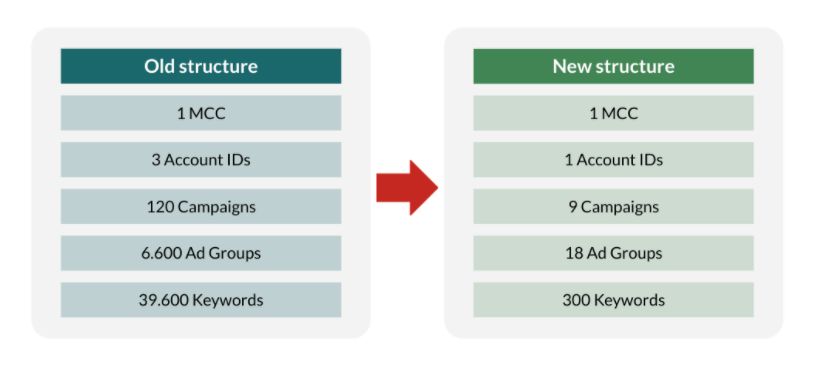
New account structure, source: Google
Are your campaigns, ad groups and keywords organized logically?
A clean account structure also includes the sensible division of the products and services offered by your company. Depending on the industry, you have divided these into one or more generic and brand-specific search campaigns, ideally in conjunction with a PMax, Demand Gen, YouTube or Shopping campaign. In this step, take a closer look at all the campaigns you have used and ask yourself for each keyword or shopping product whether it is positioned thematically correctly in the corresponding campaign or ad group.
Once you have answered these questions for yourself, you can start cleaning up your account accordingly. Remove unnecessary ad groups, underperforming keywords, and outdated assets and add potentially successful new keywords, ad groups, and ad extensions to your account
Step 3: Critically evaluate ads and landing pages
The quality of your ads is the be-all and end-all of a good advertising campaign. After all, this is the factor that should ultimately convince your customers to click on your advertising campaign. So check your ads carefully:
Are you already using at least one Responsive Search Ad (RSA) in every ad group?
Check whether each of your ad groups already has at least one responsive search ad stored. If there are still outdated and no longer customizable ETAs in your ad groups, they must be checked for accuracy and paused if performance is poor.
Are the headlines, ad texts and assets you stored still relevant?
Headlines and ad texts should be checked regularly and adjusted if necessary. For example, if you have discounts in your headlines that are no longer current, this could confuse the user. With responsive search ads, you also have the option to examine the performance of each headline and ad text individually. This will help you evaluate and optimize.
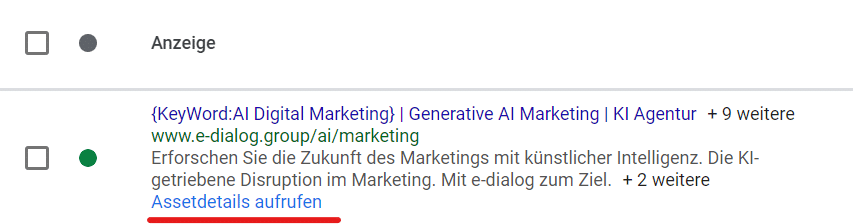
Asset details, source: Google Ads
How is the ad effectiveness of your RSA ads?
The effectiveness of responsive search ads is a very important factor in assessing the quality of your ads and can not only have a positive effect on your click rate, but especially on your cost per click. This means you can really save money here. Therefore, make sure that your ad effectiveness is rated at least “Good” and ideally “Very Good”.

Ad effectiveness, source: Google Ads
Can you link to an even more relevant landing page?
One factor that is unfortunately often not given the importance it deserves is the landing page to which your ads link. Pay close attention to whether your ads and keywords are 100% thematically consistent with your landing page. If this is not the case, it will only lead to user confusion and poorer quality of your ads.
So make sure your ads are attractive and tailored to your target audience. Your landing pages should be relevant, user-friendly and conversion-optimized.
Step 4: Check target groups and keyword types
Every good Google Ads campaign should at least have target groups defined at the observation level. Ideally, you’ll also run campaigns with targeting-level audiences. Therefore, check the audience targeting of your campaign and analyze its performance
You should also think about keyword match types. Are you still using Exact and Phrase matchtypes? Consider whether it might make sense to also test broad keywords in select ad groups.
Step 5: Analyze budget allocation and bidding strategies
Efficient budget allocation can make the difference between an average campaign and an outstanding one. Make sure your budget is focused on the best-performing campaigns and keywords. Regularly check whether your high-performing campaigns are constrained by budget. Also, review your bidding strategies and adjust as necessary for optimal results.
Step 6: Evaluate performance data
Thorough analysis of your campaigns’ performance data is essential for a successful audit. Use the data available from your Google Ads account to gain deep insights into the performance of your campaigns. Compare your results to industry benchmarks to identify potential and areas for improvement. For example, you can take a look at the auction data for your campaigns and analyze which competitors are bidding against you, how the impression share is distributed and who is most often featured first.
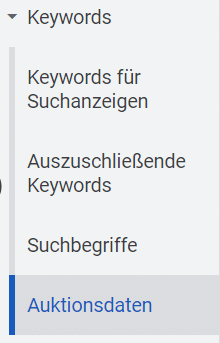
Auction data, source: Google Ads
Step 7: Continuous optimization and adjustment
Don’t be afraid to experiment with different ad formats, audiences, and keywords. A/B testing can help you identify the most effective elements of your campaigns. Remember that regular audits are crucial to ensure continuous improvement.
Conclusion
A Google Ads audit should be viewed as an ongoing process that is essential to the long-term success of your online advertising strategy. This blog article only shows a first approach for a Google Ads audit. An expert review of the entire account to determine its usefulness and performance goes into much more detail and, depending on the size of the account, can take several hours. Continuous reviews and adjustments ensure that your campaigns remain efficient and that you get the most out of your advertising budget.
Additional recommendations
- Use analysis tools: Integrate Google Analytics to gain additional insights into the behavior of your target group.
- Seek professional assistance: Consider consulting experts or consultants for specific challenges and deeper audits.
With this quick guide, you’ll be prepared to perform an initial Google Ads audit on your account to take your advertising campaigns to new levels.