3 Success Factors For Your Linkedin B2b Strategy

Management Summary
To effectively use LinkedIn for B2B marketing, it’s crucial to understand how the platform uniquely works and adapt your strategy accordingly. Through data-driven tracking and tailored ads, you can target LinkedIn’s professional users and achieve long-term growth.
LinkedIn is not Google or Meta
The first crucial step is to understand that LinkedIn’s algorithm, features and users work differently than other channels. What works well on other platforms might not perform as well on LinkedIn. This applies to both ads and automated features such as automated audience expansion.
The golden rules are:
- Adjust your strategy and ads accordingly.
- Test each feature and see what works for you. Don’t make assumptions, there is no one-size-fits-all strategy.
Create a solid data basis
LinkedIn offers a huge opportunity for B2B marketing with its highly professional user base and sophisticated targeting options. However, reaching this audience can also be quite costly, as CPM and CPC prices tend to be much higher than on other platforms. In addition, the purchase timelines in the B2B sector are longer. Accurately assessing results and setting up data-driven creative testing requires a solid tracking and attribution setup.
First of all, the following tools should not be missing from every marketer’s LinkedIn toolkit:
- Insight Tag: the platform’s cookie-based tracking pixel. Make sure to enable advanced conversion tracking in the tag’s settings. This adds first-party cookies and click IDs to your ad URLs to enable more accurate conversion tracking.
- Conversion API: As cookie-based solutions become increasingly unreliable, it is important to also set up server-side tracking for more accurate data. If necessary, consider offline conversions as well.
- UTM parameters at campaign or ad level
These tools provide a good database to build on. However, the data itself should be integrated holistically into your analyzes and reports. Break down silo thinking and focus on data-driven attribution and a better understanding of incrementality for your product.
Address all relevant decision-makers
While the final decision may be made by one or two decision makers, B2B investments usually involve multiple people.A surveyshows that in 36% of cases between 4 and 6 people are involved in the purchasing process.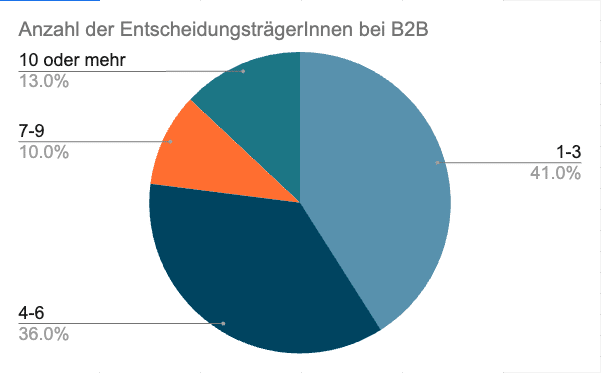 Number of relevant decision-makers, source: e-dialog
This is where LinkedIn’s unique features come into play. Use the platform’s capabilities to reach each of these decision makers and provide a personalized advertising experience. Source: UnsplashAs for the targeting itself, there are some best practices to consider:
- Don’t target based on job title. These vary greatly from company to company. Instead, target by function, seniority and skills.
- Pay attention to the size of the target group. Try not to narrow the target audience too much, but also stay relevant. Depending on your company’s profile and your marketing goal, you should have a potential reach of 80k to 200k people.
- Remember to exclude all irrelevant audiences. This means that you’re not only excluding your recent buyers, but also competitors’ employees (for ads that have nothing to do with employer branding) or even your own employees. Decide what suits your situation and create efficiencies wherever possible.
- Disable Audience Expansion and Audience Network. They often result in top-of-funnel metrics being somewhat exaggerated – at the expense of quality and relevance.
Extra tip: Check your website target group analysis. This feature is a powerful tool that gives you additional insight into the audiences that are relevant to you and uncovers any blind spots.
Fight ad fatigue with personalization
 source“Content is King” is a saying that is often used in social media marketing and is no less relevant for the B2B sector. As already mentioned, several people are involved in this process. Each of them has their own expectations of your product and will respond to different USPs.
Don’t know where to start? You can customize your existing content. LinkedIn is also a strong platform for knowledge sharing, so show off your expertise.
In general, you should note the following:
- Create platform-specific ads. While it’s understandable that you want to market with a consistent message and be efficient in your ad creation, the same ads that would work in programmatic advertising, for example, might not work on LinkedIn. Make sure you tailor your ads to LinkedIn users’ interests and behavior.
- Create a testing roadmap. Determine the hypotheses you want to test, your most important KPI, and plan for sufficient and relevant variation in your campaigns. Be prepared for longer trial periods as B2B purchases are a longer process.
- Plan LinkedIn-specific ad formats, such as: B. Thought leadership ads. For a comprehensive breakdown seethis article.
- Include at least 4 ads in each campaign.
Make sure you have a good mix of branding and activation measures. While conversion campaigns can produce short-term results, most of your potential customers are not in-market right now. But that will change. For long-term growth, you should also invest in brand building on LinkedIn. Top-of-mind is the first choice.
Conclusion:
LinkedIn can be a very powerful marketing tool for companies advertising in the B2B space. By prioritizing data fitness, engaging all relevant decision makers, and focusing on a solid creative strategy that follows best practices, LinkedIn can be a powerful performance driver for your business goals.